CUET PG Psychology Preparation 2027: Why Students Should Start Early
CUET PG Psychology has become one of the most important entrance pathways for Indian students who want to pursue MA Psychology, MSc Psychology, Applied Psychology, Clinical Psychology, Counselling Psychology, or related postgraduate programmes. For many BA Psychology students, final-year learners, and graduates from other backgrounds, the exam is not just another test. It is a major step toward higher education, university admissions, research exposure, counselling training, and long-term psychology career planning.
Because the competition is growing, students need more than last-minute reading. A strong CUET PG Psychology preparation 2027 plan should combine syllabus clarity, concept revision, mock practice, previous-year question analysis, time management, and guided doubt-solving. It should also help students understand how psychology topics connect with real academic and career goals.
The official CUET PG process is conducted through the National Testing Agency, and students should always check the latest syllabus, information bulletin, eligibility requirements, application dates, exam pattern, and university-specific admission rules from official sources before making decisions. Coaching and preparation support can help with structure, but official notifications should remain the primary reference for exam-related decisions.
Who Should Prepare for CUET PG Psychology 2027?
CUET PG Psychology is relevant for students who want to pursue postgraduate psychology programmes in India through participating universities. It is especially useful for students who are serious about building a career in psychology, mental health education, counselling-related learning, research, academic psychology, HR, school counselling, child development, social work intersections, and behavioural science.
BA Psychology students
If you are currently studying BA Psychology, CUET PG preparation can begin during your second or final year. Early preparation helps because you already study many core concepts in college, such as learning, memory, motivation, personality, social psychology, developmental psychology, abnormal psychology, research methods, statistics, and testing basics. With a structured plan, you can turn your college knowledge into entrance-ready preparation.
Graduates from non-psychology backgrounds
Some students from education, sociology, social work, philosophy, English, life sciences, management, or other backgrounds also explore MA Psychology programmes. Such students should carefully check each university’s eligibility criteria because requirements can differ. If eligible, they may need more time for basic psychology concepts, terminology, theories, and research methods.
Students targeting MA Psychology, MSc Psychology or Applied Psychology
Different universities may offer different programme names and specialisations. Some students may want a general MA Psychology programme, while others may prefer Applied Psychology, Counselling Psychology, Organisational Psychology, or related areas. CUET PG preparation helps students compete for admissions, but the final choice should depend on eligibility, curriculum, faculty, university reputation, location, fees, and career goals.
CUET PG Psychology Syllabus: What to Focus On
Before starting preparation, students should review the latest official CUET PG Psychology syllabus. While students must confirm the current syllabus from NTA, the broad preparation usually involves core psychology domains that are also taught in Indian undergraduate psychology programmes.
General psychology and foundations
This area may include the history of psychology, major schools of psychology, methods of psychology, biological bases of behaviour, sensation, perception, attention, learning, memory, thinking, intelligence, motivation, emotion, and consciousness. Students should not only memorise definitions but also understand examples and differences between similar terms.
Developmental psychology
Developmental psychology often includes physical, cognitive, emotional, social, and moral development across life stages. Students should revise theorists such as Piaget, Erikson, Kohlberg, Vygotsky, Bowlby, and other major contributors. Indian examples can help in remembering concepts, such as school readiness, adolescence, parenting style, peer influence, and ageing.
Social psychology
Social psychology is important because it connects theory with everyday human behaviour. Students should study attitude, persuasion, conformity, obedience, prejudice, stereotypes, group behaviour, leadership, interpersonal attraction, aggression, prosocial behaviour, and attribution. Entrance questions often test clarity between concepts, experiments, and applications.
Personality and individual differences
Personality theories are a high-yield area. Students should prepare psychoanalytic, trait, humanistic, behavioural, social-cognitive, and Indian perspectives where relevant. They should revise major theorists and compare theories using simple tables. Intelligence, creativity, aptitude, and individual differences should also be revised with examples.
Abnormal psychology and mental health awareness
Students should learn basic concepts related to abnormality, classification, anxiety-related conditions, mood-related concerns, psychotic disorders, personality disorders, stress, adjustment, and mental health support. However, preparation should remain educational. Students should avoid self-diagnosis or diagnosing others based on exam notes. For career learning beyond entrance preparation, students may later explore structured counselling or psychotherapy training pathways.
Research methods and statistics
Research methods and statistics can decide the difference between average and strong performance. Students should revise variables, hypothesis, sampling, experimental designs, correlation, reliability, validity, scales of measurement, descriptive statistics, normal distribution, t-test, ANOVA basics, chi-square, correlation, regression basics, and interpretation of results. Practice is essential here because many students lose marks due to formula confusion or weak conceptual clarity.
Psychological testing and assessment basics
Students should understand the basics of psychological assessment, test construction, reliability, validity, norms, standardisation, projective techniques, intelligence testing, personality assessment, and ethical use of tests. Those interested in deeper applied learning can explore Cognizavest’s Certificate Course in Psychodiagnostics after understanding the entrance-level basics.
CUET PG Psychology syllabus at a glance
The official syllabus groups Psychology into the following 13 areas:
- Introduction to Psychology
- History of Psychology
- Schools of Psychology
- Biological Bases of Behaviour
- Learning and Memory
- Sensation and Perception
- Emotion and Motivation
- Intelligence
- Personality
- Psychological Testing
- Life-span Development
- Abnormal and Clinical Psychology
- Statistics for Psychology
These are broad headings, not a chapter-by-chapter reading list. Your undergraduate syllabus may have used different unit names or placed concepts in different semesters. The useful task is to map what you already know to these 13 areas, identify gaps, and revise each area through definitions, theories, contrasts, researchers, applications and objective questions.
CUET PG Psychology exam structure: what the syllabus means in practice
For CUET PG 2026, the general examination scheme stated that each paper was conducted as a computer-based test with 75 questions in 90 minutes. Each correct answer carried four marks, while one mark was deducted for an incorrect answer. The Psychology syllabus document also specifies that all questions are compulsory, subject-specific and bilingual in English and Hindi. Where an English/Hindi wording difference arises, NTA’s information bulletin states that the English version is treated as final for non-language papers.
This creates two preparation demands at once:
- Breadth: You need workable recall across all 13 areas; ignoring statistics or biological psychology can leave avoidable gaps.
- Speed with precision: 90 minutes for 75 questions is about 72 seconds per question on average. You need to recognise concepts and eliminate options efficiently, not write long theoretical answers in your head.
Negative marking makes random guessing costly. A better rule is: attempt questions when you can identify the correct answer, eliminate options with a sound reason, or make a well-supported choice; flag genuinely uncertain questions for review if time remains.
How to use previous questions and mock tests well
Previous questions and mock tests are valuable for identifying the style of recall and application required, but they should not replace syllabus coverage. Treat them as diagnostic tools. After a mock, ask:
- Which of the 13 syllabus areas produced most errors?
- Did I miss questions because I did not know the concept, or because I misread the wording?
- Which topics take too long?
- Which notes or flashcards need to be simplified before the next revision?
As a final-stage strategy, revise in mixed sets rather than completing one unit at a time. A real paper moves rapidly from biology to personality to statistics, so your practice should train quick switching without losing conceptual accuracy.
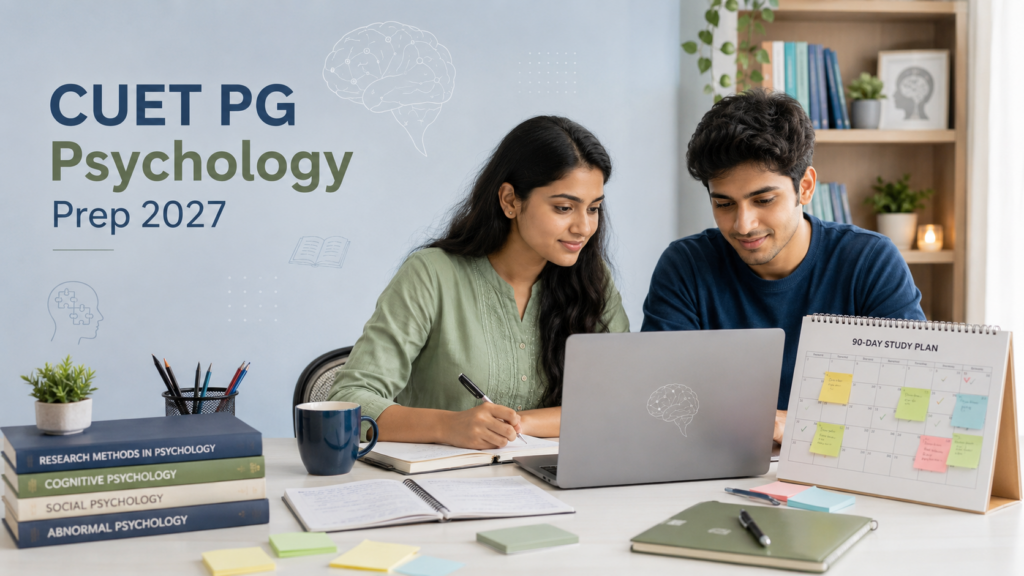
90-Day CUET PG Psychology Study Plan for the 2027 Batch
A 90-day plan works well for students who can study consistently. It is long enough to revise the syllabus and short enough to stay focused. Students who are starting from zero may need more time, while those with a strong psychology background may use the plan for revision and testing.
Days 1 to 30: Build the foundation
In the first month, focus on understanding the syllabus and completing major theory areas. Study general psychology, learning, memory, motivation, emotion, developmental psychology, and social psychology. Make short notes for each chapter. Do not copy long paragraphs from books. Instead, create concept maps, definitions, examples, and theorist comparison tables.
During this phase, students should also begin a daily psychology vocabulary habit. Write ten important terms every day, such as reinforcement, schema, attribution, validity, standardisation, intrinsic motivation, cognitive dissonance, defence mechanism, attachment, and correlation. Entrance questions often become easier when terminology is clear.
Days 31 to 60: Strengthen high-yield areas
The second month should focus on personality, abnormal psychology, research methods, statistics, psychological testing, and assessment basics. These topics need more active recall and practice. For research and statistics, solve small problems regularly. For abnormal psychology, create tables that compare symptoms, broad categories, and theoretical perspectives at an exam-appropriate level.
Students should start topic-wise MCQs in this phase. After every test, write down mistakes in a separate notebook. The mistake notebook should include the question topic, why the answer was wrong, and the correct concept. This one habit can improve performance more than repeatedly reading the same chapter.
Days 61 to 90: Revise, test and improve speed
The final month should be test-heavy. Attempt mock tests, previous-year-style questions, and timed practice sets. Review every mock seriously. A mock test is not only for scoring; it is a diagnostic tool. It shows which topics are weak, where you are guessing, where you are slow, and where you are overconfident.
By the last two weeks, students should stop collecting too many new resources. Instead, revise short notes, formulas, theorist tables, key experiments, major concepts, and mistakes from practice tests. Consistency is more important than panic study.
How to Study Psychology for Entrance Exams
Psychology entrance preparation needs a slightly different approach from college exams. In college, students often write long answers. In entrance exams, students must recognise concepts quickly and choose the most accurate option. That means preparation must include both conceptual depth and MCQ practice.
Use active recall
After studying a topic, close the book and explain the concept in your own words. For example, explain classical conditioning using a real-life example. Explain the difference between reliability and validity. Explain how conformity differs from obedience. This improves memory and reduces confusion.
Make comparison tables
Many psychology topics are similar. Students often confuse reinforcement and punishment, correlation and causation, reliability and validity, Piaget and Vygotsky, Freud and Erikson, or attitude and belief. Comparison tables help clarify these differences quickly.
Practice MCQs after every topic
Do not wait until the syllabus is complete. After each topic, solve a small set of questions. This trains your brain to apply concepts. It also tells you whether you understood the chapter or only read it passively.
Revise weekly
Every Sunday, revise what you studied during the week. Without revision, psychology terms can become confusing. Weekly revision keeps concepts fresh and reduces exam stress.
Common Mistakes in CUET PG Psychology Preparation
The first mistake is starting without reading the syllabus. Students often buy books, watch videos, or join random groups without knowing what the exam requires. The syllabus should guide every study decision.
The second mistake is ignoring research methods and statistics. Many students prefer theory topics and delay statistics until the end. This creates fear and weak performance. Statistics should be studied in small daily portions.
The third mistake is collecting too many resources. One good book, official syllabus, class notes, mock tests, and guided coaching can be enough if used properly. Too many PDFs and videos create confusion.
The fourth mistake is treating coaching as a replacement for self-study. Good CUET PG Psychology coaching can provide structure, explanation, tests, doubt-solving, and discipline, but the student still needs regular revision and practice.
The fifth mistake is ignoring university-specific admission rules. CUET PG scores may be used by participating universities, but students should check each university’s programme, eligibility, counselling process, subject code, cut-off trends, documents, and admission rules separately.
How Cognizavest’s CUET PG Psychology Coaching for 2027 Batch Can Help
Cognizavest is preparing to support Indian students through structured CUET PG Psychology learning for the 2027 batch. Students who want a guided pathway can explore Cognizavest’s CUET PG Psychology page for upcoming batch details.
A good coaching programme should help students understand the syllabus, plan their weekly study routine, revise high-yield topics, practise MCQs, clarify doubts, and prepare with discipline. It should also make psychology learning less overwhelming by breaking large topics into manageable lessons.
Students who want broader psychology exposure may also explore Certificate Course in Counseling & Psychotherapy, and Psychological Assessment. These are useful for learning beyond entrance preparation, but students should choose based on their academic stage and goals.
CUET PG Psychology Books and Resources: What Students Should Remember
There is no single magic book for psychology entrance success. Students should use resources that match the syllabus and explain concepts clearly. Undergraduate psychology textbooks, NCERT psychology books for basic revision, class notes, standard psychology references, previous-year-style questions, and mock tests can all be useful. However, resources should be selected carefully so that preparation remains focused.
When selecting books or coaching material, ask three questions. Does this match the syllabus? Is the explanation clear? Does it include practice questions? If the answer is yes, the resource is useful. If not, it may waste time.
Final Tips for CUET PG Psychology 2027 Aspirants
Start early, revise consistently, practise MCQs, and keep your preparation realistic. Do not wait for motivation every day. Build a study routine. Even two focused hours daily can create strong progress when used properly.
Also remember that CUET PG is an entrance exam, not the entire psychology journey. Your long-term growth will depend on your postgraduate learning, internships, supervision, research skills, ethical awareness, communication skills, and continued training. Use the exam as a gateway, but keep your larger goal in mind.
Soft CTA: If you are planning to prepare for CUET PG Psychology 2027 and want structured guidance, topic-wise preparation, MCQ practice and doubt support, you can explore Cognizavest’s upcoming CUET PG Psychology coaching programme and connect with the team for 2027 batch details.
FAQs on CUET PG Psychology Preparation 2027
1. When should I start CUET PG Psychology preparation for the 2027 batch?
Students should ideally start 6 to 9 months before the exam. However, a focused 90-day study plan can also work for students who already have a strong psychology foundation and can study consistently.
2. Is CUET PG Psychology difficult?
The exam can feel difficult if preparation is unstructured. Students who understand the syllabus, revise core concepts, practise MCQs, and take mock tests regularly can improve their confidence and performance.
3. Can non-psychology students prepare for CUET PG Psychology?
Some non-psychology students may be interested in postgraduate psychology programmes, but eligibility rules vary across universities. Students should check the official eligibility criteria of each university before applying.
4. What topics are important for CUET PG Psychology?
Important areas usually include general psychology, developmental psychology, social psychology, personality, abnormal psychology, research methods, statistics, testing, and assessment basics. Students should confirm the latest official syllabus before preparing.
5. Is coaching necessary for CUET PG Psychology?
Coaching is not compulsory, but it can help students who need structure, explanation, discipline, MCQ practice, doubt support, and a clear study plan. Self-study can also work if the student is consistent and understands the syllabus well.
6. How many mock tests should I take for CUET PG Psychology?
Students should begin with topic-wise practice and later attempt full-length mock tests. In the final month, one to two mock tests per week can be useful, followed by detailed analysis of mistakes.
7. Where can I find CUET PG Psychology coaching for the 2027 batch at Cognizavest?
You can visit Cognizavest’s CUET PG Psychology page for 2027 coaching batch details and enquiry options.