



















Certificate Course in Relationship Counseling · Practitioner LevelEvery argument has a pattern. Learn to see the dance.
A live, online relationship counseling course for anyone drawn to how people love, fight and repair. In 3 months, learn couple and family dynamics, attachment, systems thinking and Gottman-informed patterns, then turn them into relational assessment, case formulation and practical counselling tools.
An illustrative pursue–withdraw cycle. Relationship counselling helps both people see the cycle as the shared problem, rather than each other.
When things get tense, do you reach or retreat?
Five quick questions about how you handle conflict with someone close to you. Most of us lean one way, and relationship counselling starts by noticing it.
Shape the triangle. Name the love.
Sternberg’s Triangular Theory of Love describes love through three components. Move the sliders and watch the relationship change shape.
This is one of 12 topic areas in the syllabus, alongside attachment, systems theory and Gottman-informed dynamics.
Reserve your seatSpot the Four Horsemen. Then find the antidote.
Four conflict patterns identified in Gottman’s research on couples. Read each moment and name the pattern.
“We fight every time your parents visit.”
The same conflict looks different through each theory you will learn. Switch lenses and see what a relationship counsellor notices, and what they might ask.
Your first couple. Four decisions.
Walk a real-to-life case from the first minute to the first intervention. Every choice maps to something the course teaches.
Ten tools you will learn to use in a real session.
Hover or tap a card to see when each tool helps.
From first dates to joint families.
The syllabus covers the relationships people actually bring to counselling, in the Indian context.
Couple & marital
- Dating and premarital concerns
- Marital adjustment
- Emotional intimacy
- Physical intimacy concerns
- Jealousy and insecurity
- Trust rupture and infidelity
- Long-term dissatisfaction
- Separation ambiguity
Family & intergenerational
- Parent–child conflict
- Sibling rivalry
- Adult child–parent boundaries
- In-law conflict
- Joint family issues
- Family loyalty vs autonomy
- Intergenerational value conflict
Social & contemporary
- Friendship rupture
- Workplace relational stress
- People-pleasing
- Social rejection
- Long-distance relationships
- Digital relationships
- Situationships
- Social media jealousy
- Intercultural and interfaith couples
- LGBTQIA+ relationship sensitivity
Open to learners from any background.
Tap the description closest to you.
Relationship counselling works within ethical limits. The course teaches contraindications, risk and safety screening and when to refer, including for couple therapy, family therapy or other specialist support.
Twelve topic areas. Three movements.
Foundations and relational theories; couple, family and contemporary dynamics; then assessment, formulation and core skills.
01Professional FoundationsMovement I · Foundations & relational theories
- Scope of relationship counselling and difference from therapy, coaching, guidance and advice
- Ethical foundations, confidentiality, informed consent, neutrality and multipartiality
- Contraindications and referral indicators
02Systems and Interpersonal TheoriesMovement I · Foundations & relational theories
- General Systems Theory, circular causality, feedback loops and relational homeostasis
- Interpersonal process theory and family-of-origin influence
- Bowenian and structural family concepts
03Attachment and Emotional BondingMovement I · Foundations & relational theories
- Adult attachment patterns and internal working models
- Attachment injuries, emotional safety and co-regulation
- Dependency, autonomy, interdependence and emotional responsiveness
04Love, Commitment and Relational MeaningMovement I · Foundations & relational theories
- Sternberg’s Triangular Theory of Love, Social Exchange Theory and Equity Theory
- Commitment, investment and cultural scripts of relationships
- Indian context of love, marriage, family and gender roles
05Couple and Marital DynamicsMovement II · Couple, family & contemporary dynamics
- Dating, premarital concerns, marital adjustment and emotional intimacy
- Physical intimacy concerns, jealousy, insecurity, trust rupture and infidelity
- Long-term dissatisfaction and separation ambiguity
06Gottman-Informed DynamicsMovement II · Couple, family & contemporary dynamics
- Sound Relationship House, love maps and bids for connection
- Four Horsemen, repair attempts, flooding and gridlocked conflict
- Shared meaning, trust and commitment
07Family and Intergenerational IssuesMovement II · Couple, family & contemporary dynamics
- Parent-child conflict, sibling rivalry and adult child-parent boundaries
- In-law conflict, joint family issues and family loyalty versus autonomy
- Intergenerational value conflict and genogram-based understanding
08Social, Workplace and Contemporary ConcernsMovement II · Couple, family & contemporary dynamics
- Friendship rupture, workplace relational stress, people-pleasing and social rejection
- Long-distance, digital relationships, situationships and social media jealousy
- Intercultural, interfaith and LGBTQIA+ relationship sensitivity
09Intake and Relational AssessmentMovement III · Assessment, formulation & core skills
- Relationship intake format, individual and dyadic intake
- Relationship timeline, critical incidents and communication pattern assessment
- Attachment pattern, family-of-origin assessment and risk/safety screening
10Case FormulationMovement III · Assessment, formulation & core skills
- 5P, systemic, attachment-based and Gottman-informed formulation
- CBT-informed and relational schema formulation
- Goal-setting in relationship counselling
11Counselling Micro-Skills and Process SkillsMovement III · Assessment, formulation & core skills
- Therapeutic alliance, balanced alliance, reflective responding and validation
- Circular questioning, reframing and de-escalation
- Managing blame, defensiveness and tracking interactional cycles
12Applied Relationship Counselling ToolsMovement III · Assessment, formulation & core skills
- Conflict cycle map, Four Horsemen worksheet and needs-expectations worksheet
- Boundary map, relationship timeline, genogram and trust reconstruction checklist
- Repair conversation template, decision clarity worksheet and couple check-in format
From relationship advice to structured counselling work.
Two lenses for the complexity of real relationships.
Tap a card to meet each trainer.
Clarity, courage and human connection.
Reflections from learners in live relationship-counselling and allied cohorts.
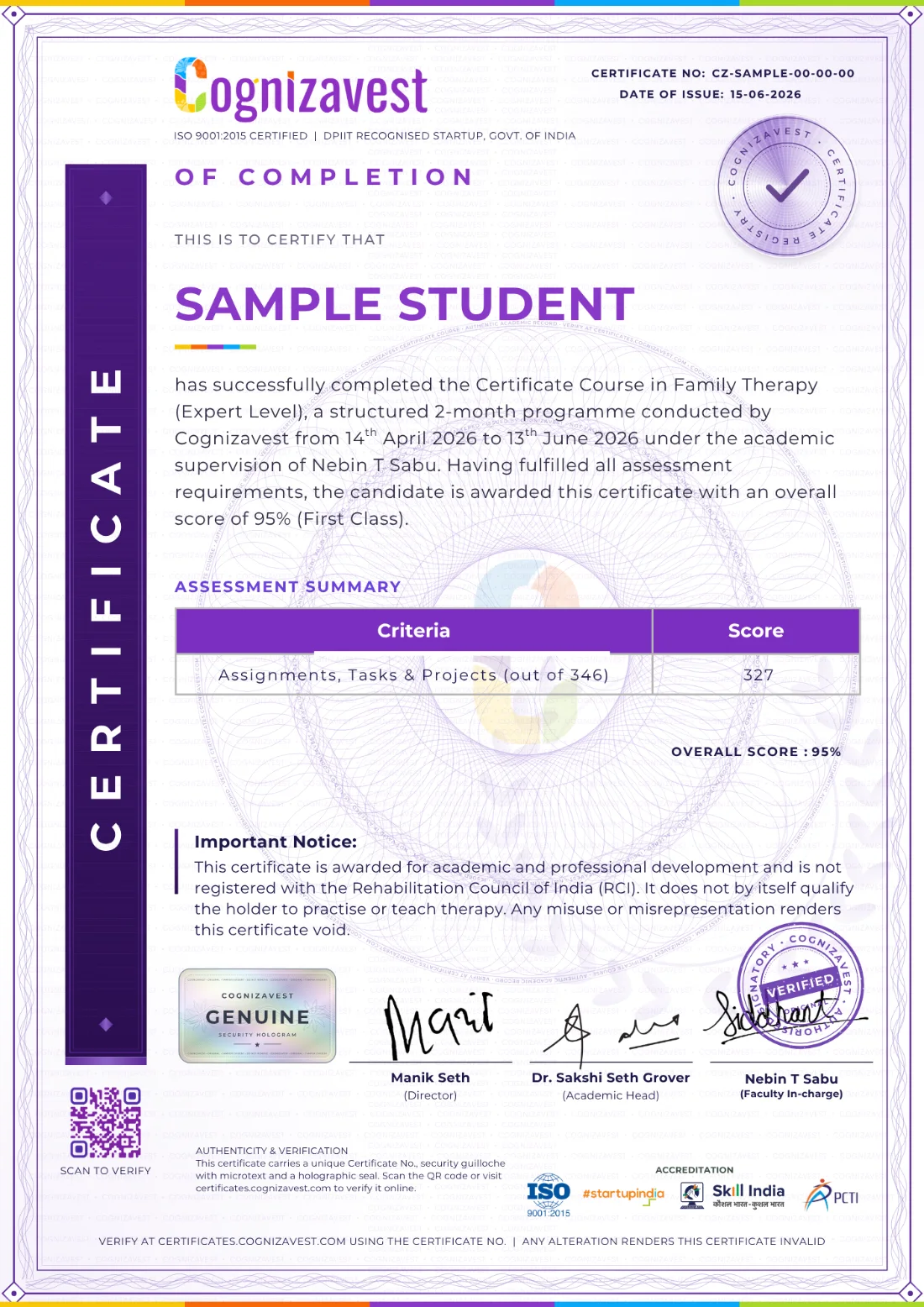
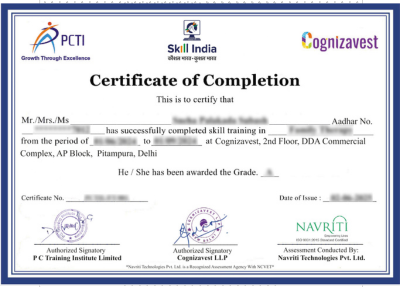
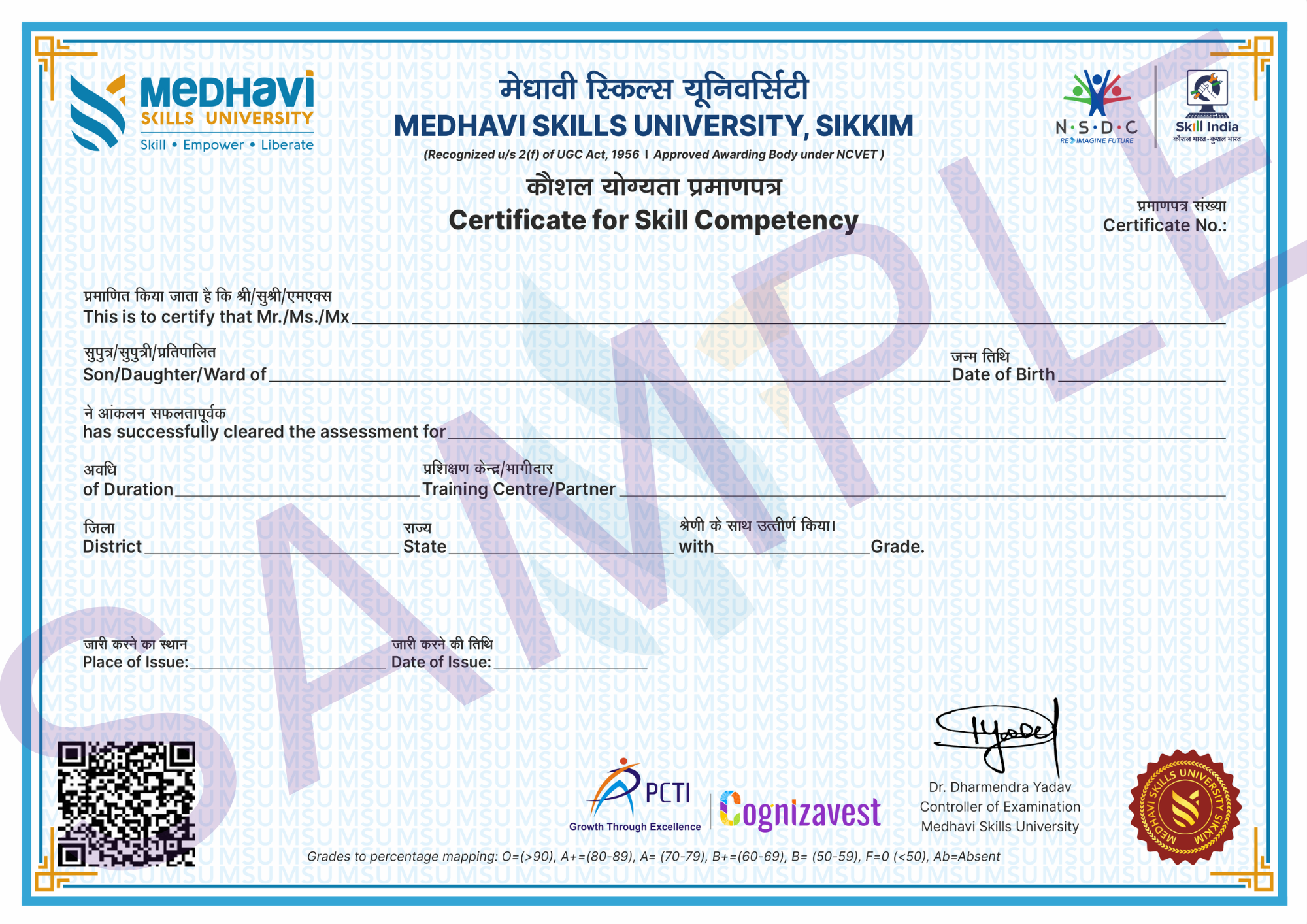
Make your relationship work visible on your profile.
The Cognizavest hardcopy Practitioner certificate is included. You can add the NCVET Skill India certificate, and can also opt for a university certificate.
- 01Cognizavest certificate Included
Hardcopy Practitioner Level certificate after course requirements are met.
- 02NCVET Skill India certificate + ₹1,500
Optional add-on for this NCVET Skill India approved, 2-credit course, opted for separately through enrollment support.
- 03University certificate + ₹2,500
Optional Certificate for Skill Competency issued by Medhavi Skills University after assessment. Can be combined with NCVET.
Note: add-on certificate fees (NCVET ₹1,500, university ₹2,500) are optional, not part of online checkout, and are collected separately by our team after you enroll.
Choose how you want to secure your seat.
Pay the complete fee, or start the monthly plan with ₹3,000 today. Add resources if you want them, and check out.
This page has 7 practice experiences. The course turns them into 60 hours of live training.
Relationship Counseling · Practitioner
Secure SSL checkout
Questions before you pay? Chat with us on WhatsApp
Clear answers before you enroll.
Tell us your background and we will help you decide if this course fits.
Ask on WhatsAppWhat is relationship counselling?
Relationship counselling helps individuals, couples and families understand the patterns in their relationships, communicate more safely, work through conflict and make clearer decisions. It draws on systems thinking, attachment theory, communication research and Gottman-informed ideas, within clear ethical limits.
When does the next batch start?
The next batch starts on 22 December 2026. Live online classes are held every Tuesday and Thursday from 12 PM to 2 PM IST.
What is the duration and fee?
The Practitioner Level course runs for 3 months, with 60 hours of training and 12+ hours of supervision-linked learning. The complete fee is ₹6,999 (incl. taxes), or you can choose the monthly plan: ₹3,000 at registration, then ₹2,000 after the first month and ₹2,000 after the second month. Add-ons are charged with the first payment.
What will I learn?
Professional foundations and ethics; systems, interpersonal and attachment theories; love and commitment; couple and marital dynamics; Gottman-informed dynamics; family and intergenerational issues; social and contemporary concerns; intake and relational assessment; case formulation; counselling micro-skills and process skills; and ten applied relationship counselling tools.
Who are the trainers?
Jerson Egipsy (Ph.D. Scholar; M.A. Clinical Psychology; MSW Counselling; MBA HR; Bachelor’s in General Law) and Zainab Malbari (postgraduate in Clinical Psychology; 3 years of experience).
Can non-psychology learners join?
Yes. The course is open to bachelor’s and master’s students and graduates from any background, and to professionals from psychology, education, social work, counselling, wellness and allied helping fields.
Are classes live? Are recordings available?
Yes. Classes are live online, with recording access as per program policy.
Which certificates will I receive?
A Cognizavest hardcopy Practitioner Level certificate for this NCVET Skill India approved, 2-credit course. You can add the NCVET Skill India certificate (₹1,500) and, as a third optional choice, a university Certificate for Skill Competency from Medhavi Skills University (₹2,500). Add-on fees are collected separately by our team after enrollment.
Will I get worksheets?
The Art of Connection — our printed relationship worksheet sets (30, 40 or 50 worksheets, from ₹899) — is available from the enrolment section.
What is the refund policy?
Cognizavest follows a strict no-refund policy for programs. Batch shifting may be considered only as per policy timeline and conditions.
Help people find their way back to each other.
Live classes every Tuesday and Thursday, 12–2 PM IST. 3 months, 60 hours plus 12+ hours of supervision. ₹6,999, or start with ₹3,000.
