



















Turn a research idea into a study you can actually design.
A beginner-friendly, two-month Certificate Course in Research and Statistics that connects quantitative research planning with statistical reasoning—so you can move from a broad topic to a structured proposal and small-scale study.
Does academic stress relate to sleep quality among university students?
The course helps you define both variables, select a sample, choose suitable tools, plan ethical data collection and match the question with an appropriate statistical analysis.
Complete the course with more than notes—leave with a research plan.
Every module supports one final independent task: designing a small-scale quantitative study and preparing its structured proposal.
Design a quantitative study from start to finish.
Bring together the research problem, variables, design, sampling, tool selection, ethics and data-analysis plan into one coherent proposal.
Identify an appropriate quantitative research problem
Develop research questions and hypotheses
Review relevant research literature
identify and define variables
Select an appropriate quantitative research design
Choose suitable sampling and data-collection methods
Construct a basic questionnaire or select an appropriate research tool
Plan data coding and analysis
Select suitable descriptive and inferential statistical procedures
Interpret basic statistical findings
Prepare a structured quantitative research proposal
Independently design a small-scale quantitative research study
Do not memorise a test list. Learn how to choose.
Select a research aim and data structure to see the reasoning the course develops.
1. What is the research aim?
2. Which structure fits?
Independent-samples t-test
A common parametric option when comparing the mean score of two independent groups and the relevant assumptions are reasonably met.
Nine modules. One connected path from question to proposal.
Open each module to inspect the complete published syllabus. The curriculum covers quantitative research and statistics without requiring prior knowledge.
Module 01Foundations of Quantitative ResearchMove from a broad interest to a feasible quantitative research topic. 16 topics +
- Meaning and purpose of research
- Research as a systematic process
- Characteristics of scientific research
- Quantitative research and its major features
- Difference between quantitative and qualitative research
- Strengths and limitations of quantitative research
- Basic, applied and action research
- Exploratory, descriptive, correlational and explanatory research
- Research in psychology, education, healthcare and social sciences
- Stages of the quantitative research process
- Identifying broad and specific research areas
- Converting an area of interest into a researchable topic
- Characteristics of a feasible research topic
- Research feasibility in terms of time, access, population and resources
- Difference between a topic, problem, question and objective
- Common mistakes made by beginner researchers
Module 02Research Problem, Objectives and HypothesesAlign the problem, objectives, questions and testable hypotheses. 20 topics +
- Meaning of a research problem
- Sources of research problems
- Identifying research gaps
- Practical, theoretical, population and methodological gaps
- Developing a research problem statement
- Establishing the need and significance of a study
- Delimiting the scope of research
- Developing research aims
- Writing specific and measurable research objectives
- Difference between aims and objectives
- Developing quantitative research questions
- Characteristics of a good research question
- Meaning and purpose of a hypothesis
- Research and null hypotheses
- Directional and non-directional hypotheses
- Simple and complex hypotheses
- Associative and causal hypotheses
- Writing statistically testable hypotheses
- Matching research questions, objectives and hypotheses
- Identifying inconsistencies in research planning
Module 03Literature Review and Research FrameworkSearch, evaluate and synthesise literature into a research framework. 22 topics +
- Meaning and purpose of a literature review
- Role of literature in quantitative research
- Identifying relevant research literature
- Primary and secondary sources
- Research articles, reviews, books, theses and reports
- Using academic databases and search engines
- Developing effective search terms
- Using keywords and Boolean operators
- Evaluating the relevance and credibility of sources
- Reading the abstract, methodology, results and discussion sections
- Organising literature according to themes
- Comparing findings across studies
- Identifying agreements, contradictions and research gaps
- Avoiding article-by-article description
- Writing a synthesised literature review
- Difference between summarising and synthesising
- Understanding theoretical and conceptual frameworks
- Selecting a framework relevant to the research problem
- Connecting previous literature with the proposed study
- Introduction to APA-style citations and references
- Plagiarism, paraphrasing and academic integrity
- Responsible use of artificial intelligence in literature-related work
Module 04Variables, Measurement and Research DesignsDefine variables, measurement levels and the most suitable design. 25 topics +
- Meaning of variables in research
- Independent and dependent variables
- Predictor and outcome variables
- Control, confounding and extraneous variables
- Mediating and moderating variables as introductory concepts
- Demographic and background variables
- Continuous and categorical variables
- Operational definition of variables
- Difference between conceptual and operational definitions
- Measurement of psychological and behavioural constructs
- Levels of measurement
- Nominal, ordinal, interval and ratio scales
- Importance of measurement level in statistical test selection
- Experimental research designs
- Independent-group and repeated-measures designs
- Pre-test and post-test designs
- Quasi-experimental research
- Correlational research
- Comparative research
- Cross-sectional and longitudinal research
- Survey research designs
- Selecting a design according to the research question
- Difference between association, prediction and causation
- Threats to internal and external validity
- Strengths and limitations of major quantitative designs
Module 05Sampling, Data Collection and Research ToolsChoose samples, tools and questionnaires with reliability and validity in mind. 34 topics +
- Meaning of population and sample
- Target and accessible populations
- Sampling frame and sampling unit
- Census and sample-based research
- Probability sampling methods
- Simple random sampling
- Systematic sampling
- Stratified sampling
- Cluster and multistage sampling
- Non-probability sampling methods
- Convenience sampling
- Purposive sampling
- Quota sampling
- Snowball sampling
- Selecting a sampling method
- Sampling bias and representativeness
- Basic considerations in determining sample size
- Relationship between sample size and statistical analysis
- Inclusion and exclusion criteria
- Surveys and questionnaires
- Standardised psychological and educational tools
- Selecting an existing research instrument
- Permission and copyright considerations
- Developing a basic researcher-made questionnaire
- Open-ended and closed-ended questions
- Likert-scale items
- Writing clear and unbiased questions
- Leading, double-barrelled and ambiguous questions
- Sequencing questionnaire items
- Pilot testing and preliminary refinement
- Reliability and validity of measurement
- Internal consistency, test-retest and inter-rater reliability
- Content, construct and criterion validity
- Difference between reliability and validity
Module 06Research Ethics and Data ManagementProtect participants and organise clean, secure, analysable data. 30 topics +
- Ethical principles in quantitative research
- Respect for autonomy
- Beneficence and non-maleficence
- Justice and fair participant selection
- Informed consent
- Voluntary participation
- Right to withdraw
- Confidentiality and anonymity
- Privacy during data collection
- Risks and benefits of participation
- Deception and debriefing
- Research involving children
- Research involving vulnerable populations
- Online data collection and digital consent
- Institutional ethics committees
- Ethical approval before data collection
- Researcher competence and responsibility
- Conflict of interest
- Fabrication, falsification and selective reporting
- Data ownership and authorship
- Preparing quantitative data for analysis
- Assigning participant identification numbers
- Coding questionnaire responses
- Developing a codebook
- Entering data into a spreadsheet or statistical software
- Identifying data-entry errors
- Missing values and incomplete responses
- Reverse scoring of questionnaire items
- Basic data cleaning
- Secure data storage and disposal
Module 07Descriptive Statistics and Data PresentationSummarise distributions through tables, graphs and descriptive statistics. 26 topics +
- Role of statistics in quantitative research
- Difference between descriptive and inferential statistics
- Understanding cases, variables and values
- Frequency and percentage distributions
- Frequency tables
- Measures of central tendency
- Mean, median and mode
- Selecting the appropriate measure of central tendency
- Measures of variability
- Range, variance and standard deviation
- Understanding consistency and dispersion
- Minimum and maximum values
- Percentiles and quartiles
- Interquartile range
- Introduction to standard scores
- Understanding the normal distribution
- Skewness and kurtosis
- Positive and negative skew
- Identifying unusual distributions
- Tables and graphical presentation
- Bar charts, pie charts and histograms
- Line graphs and scatterplots
- Selecting an appropriate graph
- Misleading data presentation
- Interpreting descriptive statistical output
- Writing descriptive findings in simple research language
Module 08Inferential Statistics and Statistical Test SelectionChoose and interpret tests of difference, relationship and prediction. 52 topics +
- Meaning and purpose of inferential statistics
- Population parameters and sample statistics
- Sampling error
- Introduction to probability
- Statistical significance
- Understanding the p-value
- Significance levels
- Type I and Type II errors
- Confidence intervals
- Effect size as a measure of practical importance
- Parametric and non-parametric statistics
- Assumptions of parametric tests
- Normality, independence and homogeneity of variance
- Identifying outliers
- Choosing a statistical test according to:
- Research question
- Number of variables
- Level of measurement
- Number of groups
- Independent or related observations
- Distribution of data
- Tests of Difference
- Independent-samples t-test
- Paired-samples t-test
- One-sample t-test as a basic concept
- One-way analysis of variance
- Post-hoc comparisons as an introductory concept
- Understanding repeated-measures ANOVA
- Mann–Whitney U test
- Wilcoxon signed-rank test
- Kruskal–Wallis test
- Tests of Relationship and Association
- Pearson correlation
- Spearman rank-order correlation
- Direction and strength of correlation
- Interpreting correlation coefficients
- Correlation does not establish causation
- Chi-square test of independence
- Introduction to simple linear regression
- Predictor and outcome variables
- Understanding regression coefficients
- Introduction to multiple regression and its purpose
- Interpretation and Reporting
- Reading statistical software output
- Identifying the relevant result within an output table
- Determining whether a finding is statistically significant
- Interpreting direction, strength and magnitude
- Connecting results with hypotheses
- Reporting findings without exaggeration
- Writing basic statistical results in APA style
- Distinguishing statistical significance from practical significance
- Avoiding unsupported causal conclusions
Module 09Developing a Quantitative Research ProposalBring every decision together in one coherent quantitative proposal. 21 topics +
- Structure of a quantitative research proposal
- Developing a clear research title
- Writing the introduction and background
- Presenting the research problem
- Establishing the rationale and significance
- Writing aims and objectives
- Developing research questions and hypotheses
- Organising the literature review
- Selecting an appropriate research design
- Defining the population and sample
- Selecting a sampling method
- Identifying and operationalising variables
- Selecting or developing research tools
- Planning the data-collection procedure
- Preparing an ethical consent process
- Developing a data-analysis plan
- Matching hypotheses with statistical tests
- Anticipating limitations and delimitations
- Developing a feasible research timeline
- Maintaining consistency across all sections
- Reviewing the proposal for methodological errors
Research clarity with two complementary perspectives.
Academic research orientation meets multidisciplinary counselling, systems and communication experience.
 Research orientation
Wasuddha Tikmani
A psychology educator whose academic grounding supports clear explanations of research questions, literature, variables, design and evidence-aware decision-making.
 Systems & facilitation
Jerson Egipsy
A multidisciplinary facilitator who connects psychological understanding with social-work counselling, systems thinking, legal awareness and practical communication.
Document a complete research-learning milestone.
A Cognizavest digital certificate is included after successful completion. Learners may additionally opt for the NCVET Skill India certificate at ₹1,500.
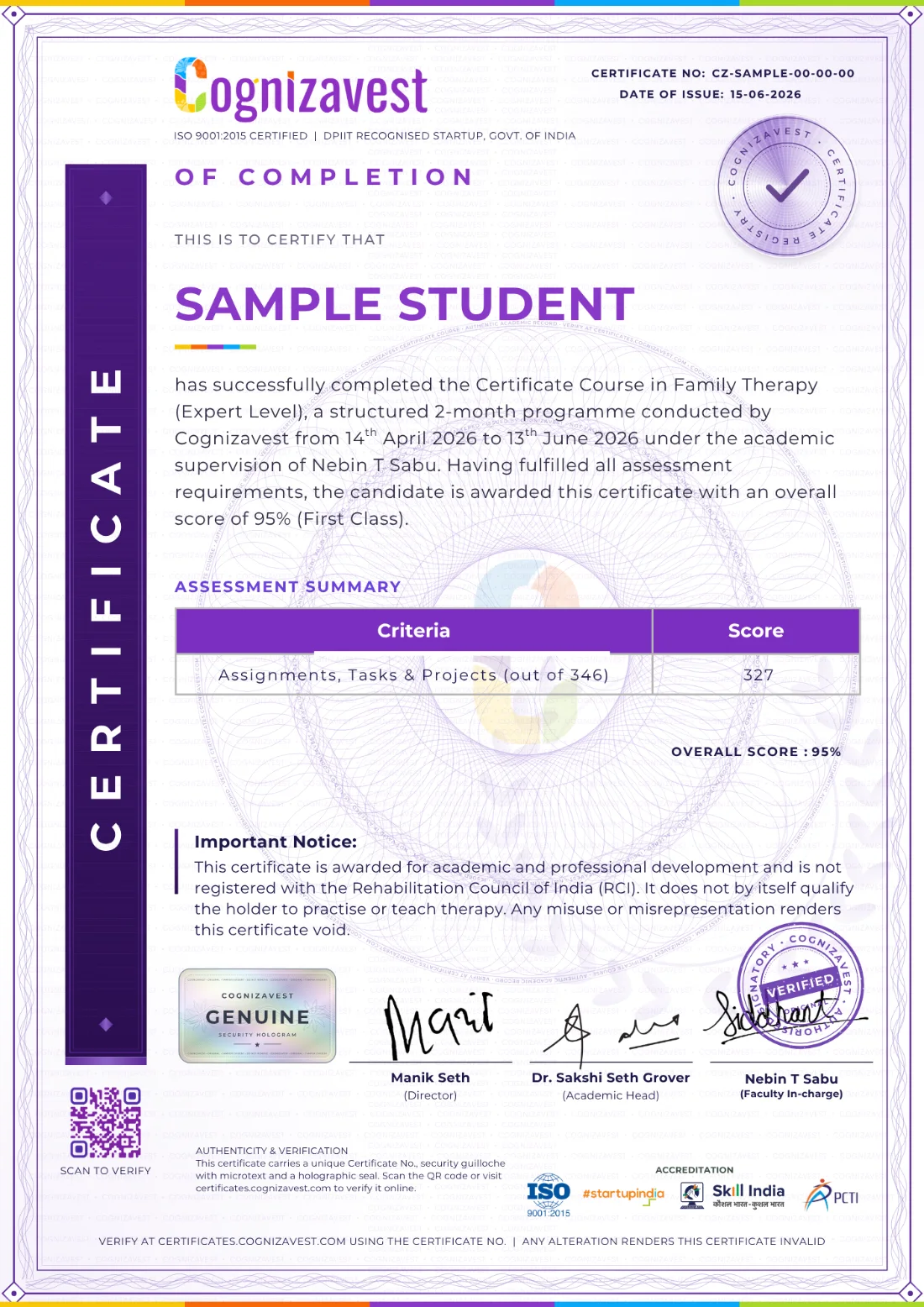 Cognizavest Certificate
 Optional NCVET Skill India
Start building the study you have been postponing.
One complete two-month pathway, 16 live classes and a clear quantitative research outcome.
14th November 2026
The cohort begins on Saturday, 14th November. Regular live classes continue every Friday and Saturday from 5 PM to 6 PM.
Research and Statistics
Clear answers before you begin the study.
Who can join this Research and Statistics course?+
The course is open to learners from all academic and professional backgrounds. No prior knowledge of research methods or statistics is required.
Is the course focused on quantitative or qualitative research?+
The primary focus is quantitative research. The course briefly distinguishes quantitative and qualitative research, then develops quantitative research design, measurement, sampling, descriptive statistics, inferential statistics and proposal development in depth.
How many live classes are included?+
The two-month program includes 16 live online classes. Classes are held twice a week for one hour each, every Friday and Saturday from 5 PM to 6 PM.
What will I complete by the end of the course?+
Learners are guided to independently design a small-scale quantitative study and prepare a structured quantitative research proposal with an aligned problem, objectives, hypotheses, design, sample, tools, ethics and data-analysis plan.
Will statistical tests be covered?+
Yes. The syllabus includes descriptive statistics, assumptions, t-tests, ANOVA, Mann–Whitney U, Wilcoxon, Kruskal–Wallis, Pearson and Spearman correlation, chi-square and introductory regression, with emphasis on choosing and interpreting the appropriate test.
Does the course include software training?+
The syllabus includes entering, cleaning and reading data and statistical output. It focuses on statistical reasoning and interpretation rather than promising mastery of one specific software package.
Which certificate is included?+
A Cognizavest digital certificate is included after successful completion of the course requirements. An optional NCVET Skill India certificate can be added separately for ₹1,500 through the post-enrollment support process.
When does the batch begin?+
The cohort begins on Saturday, 14th November 2026. Regular live classes are scheduled every Friday and Saturday from 5 PM to 6 PM.
