









De-addiction Counselling Course · Online CertificateRecovery starts when the loop is broken.
A live, practice-first Certificate Course in De-addiction Counselling. Learn how addiction works in Indian lives and families, then build the counsellor’s toolkit: screening, motivation, family work, relapse prevention, craving tools, crisis handling and ethics, with clear referral boundaries.
Trigger → craving → permission thought → use → aftermath
Every lapse follows a pattern. A counsellor helps the client see it, then interrupts it at more than one point.
A craving is a wave. It rises, peaks and passes.
Urge surfing teaches clients to notice a craving without acting on it, and watch it fall away. Try a short, guided version.
- Notice where the urge shows up in the body
- Breathe slowly; name it, don’t fight it
- Ride the peak, then watch it fall
Press start and follow the cues for about 15 seconds.
Illustration for learning. Real cravings vary in length; the skill is taught with practice in the course.
Meet the client where they are, not where you wish they were.
Readiness changes how a session should sound. Step through the stages of change.
Lapses can happen at any stage. Good counselling treats them as information, not failure, and helps the client re-enter the cycle.
Counsel, or refer? Safety depends on knowing.
One of the most important skills in this course is recognising what a counsellor can safely work on, and what needs urgent medical or crisis support. Sort six situations.
From addiction understanding to safe counselling support.
Tap a learner goal to see the skill pathway this course builds.
Three levels. Each one builds on the last.
A clear pathway from addiction foundations to practitioner-level counselling application. Fees include taxes.
Beginner
Foundations and supportive counselling
Modules 1–4 of 12
- Addiction foundations in the Indian context
- Supportive counselling essentials and screening
- Motivation and stages of change
- Withdrawal red flags and referral
Expert
Everything in Beginner, plus
Modules 1–8 of 12
- Risk identification basics
- Working with families
- Relapse loop and functional analysis
- Comorbidities and dual diagnosis
Practitioner
₹3,000 now · ₹2,000 after month 1 · ₹2,000 after month 2
All 12 modules
- Special populations: adolescents, women, elderly, workplace
- Advanced risk and crisis handling
- Craving and urge management toolkit
- Ethics and Indian legal awareness · Practitioner certificate
Twelve modules. From first session to crisis plan.
The full de-addiction counselling syllabus, level by level. Filter to see exactly what your fee includes.
Beginner Level · Foundations · 1 Month
01Foundations of Addiction (India-specific)6 topics
- Addiction vs habit vs dependence with simple clinical differentiation
- Indian realities: stigma, secrecy, family control and “log kya kahenge”
- Substance-use spectrum: experimentation → risky use → dependence
- Behavioral addictions: gaming, gambling, porn/sex, shopping and social media
- Alcohol, nicotine/tobacco, cannabis, opioids, stimulants, sedatives and inhalants
- Prescription misuse without pharmacology depth
02Counselling Essentials (Supportive)6 topics
- Therapeutic alliance in addiction cases
- Non-judgmental language, validation, containment and goal setting
- Handling denial, minimization, blame and shame with supportive scripts
- First session structure: what to ask and what to avoid
- Basic screening logic: severity, functioning, risk and supports
- Substance and behavioral addiction pattern mapping
03Motivation Basics (Readiness)4 topics
- Stages of change from precontemplation to maintenance
- Motivation vs compliance
- External pressure vs internal choice
- Brief intervention approach for 1–2 sessions
04Withdrawal & Detox Basics + Referral3 topics
- Common withdrawal patterns at a high level
- Urgent medical referral red flags: severe withdrawal, seizures, delirium and overdose risk
- What a counsellor can safely do vs what must be referred
Expert Level · Risk, Family & Formulation · 2 Months
05Risk Identification Basics4 topics
- Suicide and self-harm warning signs in addiction contexts
- Violence risk flags and safety boundaries
- Overdose risk awareness with non-medical emergency protocol mindset
- Referral pathways and documentation basics
06Working with Families6 topics
- Enabling vs supporting
- Codependency basics and family pressure in Indian households
- What helps and what harms at home
- Family session structure, rules and blame-cycle management
- Managing parents, spouse, in-laws and other stakeholders
- Psychoeducation package for recovery support at home
07Advanced Case Formulation3 topics
- Bio-psycho-social formulation with 5Ps adapted for addiction
- Relapse loop: trigger → craving → permission thought → use → aftermath
- Functional analysis: what the substance or behavior is doing for the client
08Comorbidities & Dual Diagnosis5 topics
- Depression + addiction maintenance cycles
- Anxiety disorders + addiction and the avoidance loop
- Trauma links without turning it into trauma therapy
- Personality traits and emotion dysregulation in relapse-prone clients
- Psychosis/mania red flags and referral coordination
Practitioner Level · Crisis, Toolkit & Ethics · 3 Months
09Working with Different Populations4 topics
- Adolescents: peer influence, vaping, gaming, school coordination and family contracts
- Women: stigma, hidden use, postpartum vulnerabilities and safety considerations
- Elderly: loneliness, pain-med misuse patterns and chronic illness context
- Workplace cases: functioning, performance pressure and confidentiality complexities
10Risk & Crisis Handling (Advanced)5 topics
- Suicide risk assessment at counsellor level
- Step-by-step safety plan creation
- Violence risk handling and domestic abuse red flags
- Overdose risk response plan with non-medical crisis readiness
- Crisis documentation: what to write and what not to write
11Craving & Urge Management Toolkit5 topics
- Urge surfing
- Delay-distraction-decide protocols
- Grounding techniques and emotion regulation micro-tools
- Stimulus control and environment redesign
- Coping cards and emergency routine scripts
12Ethics + Indian Legal Awareness5 topics
- NDPS Act practical awareness as non-legal advice
- Confidentiality, consent, family demands, minors and documentation safety
- Forced admission pressure, employer influence and spouse surveillance
- Professional boundaries with relapse and repeated crisis calls
- Police/legal involvement, custody disputes and domestic violence contexts
From “I understand addiction” to “I can respond safely.”
Many addiction trainings stop at definitions. This program focuses on application: screening, family work, relapse loops, risk handling, ethics and referral clarity.
Readiness for real-world helping roles.
Learners build readiness to understand addiction presentations, support motivation, map relapse loops, guide families, manage counsellor-level risk and know when medical, psychiatric or crisis referral is required.
- Supportive counselling
Practise supportive addiction counselling with structured scripts, case mapping and referral clarity.
- Addiction foundations
Understand substance-use and behavioral addiction patterns without turning the course into medication training.
- Family context
Learn how stigma, secrecy, family pressure and Indian household dynamics affect recovery conversations.
- Risk identification
Build readiness to identify risk flags, withdrawal red flags and situations that require urgent referral.
- Relapse formulation
Use relapse-loop formulation to understand triggers, cravings, permission thoughts, use and aftermath.
- Craving management
Develop a practical craving-management toolkit with urge surfing, coping cards and emergency routines.
- Family psychoeducation
Learn how to guide families from enabling and blame cycles toward recovery-supportive actions at home.
- Professional boundaries
Build ethical clarity around confidentiality, consent, repeated crisis calls, minors and documentation safety.
Settings that use these skills
Certification documents training. It does not by itself authorise independent clinical practice; apply skills within your role, scope and supervision.
Skills you leave with
Cognizavest community. Alumni get access to events, supervision programs and offline community meet-ups across India.
Meet your trainers.
Learn from trainers with psychology and clinical counselling backgrounds.

Ayesha Narmawala
PGDRP (RCI CRR-A85502) · M.A. Clinical Psychology · B.A. Psychology
Extensive experience in advanced diagnostics and therapeutic intervention, bringing assessment depth and practical case thinking to addiction counselling.

Wasuddha Tikmani
3 years of experiencePh.D. Scholar · M.A. Clinical Psychology · B.A. Psychology · SET Qualified
Brings clinical psychology grounding, structured learning and research-oriented clarity to addiction counselling learning.
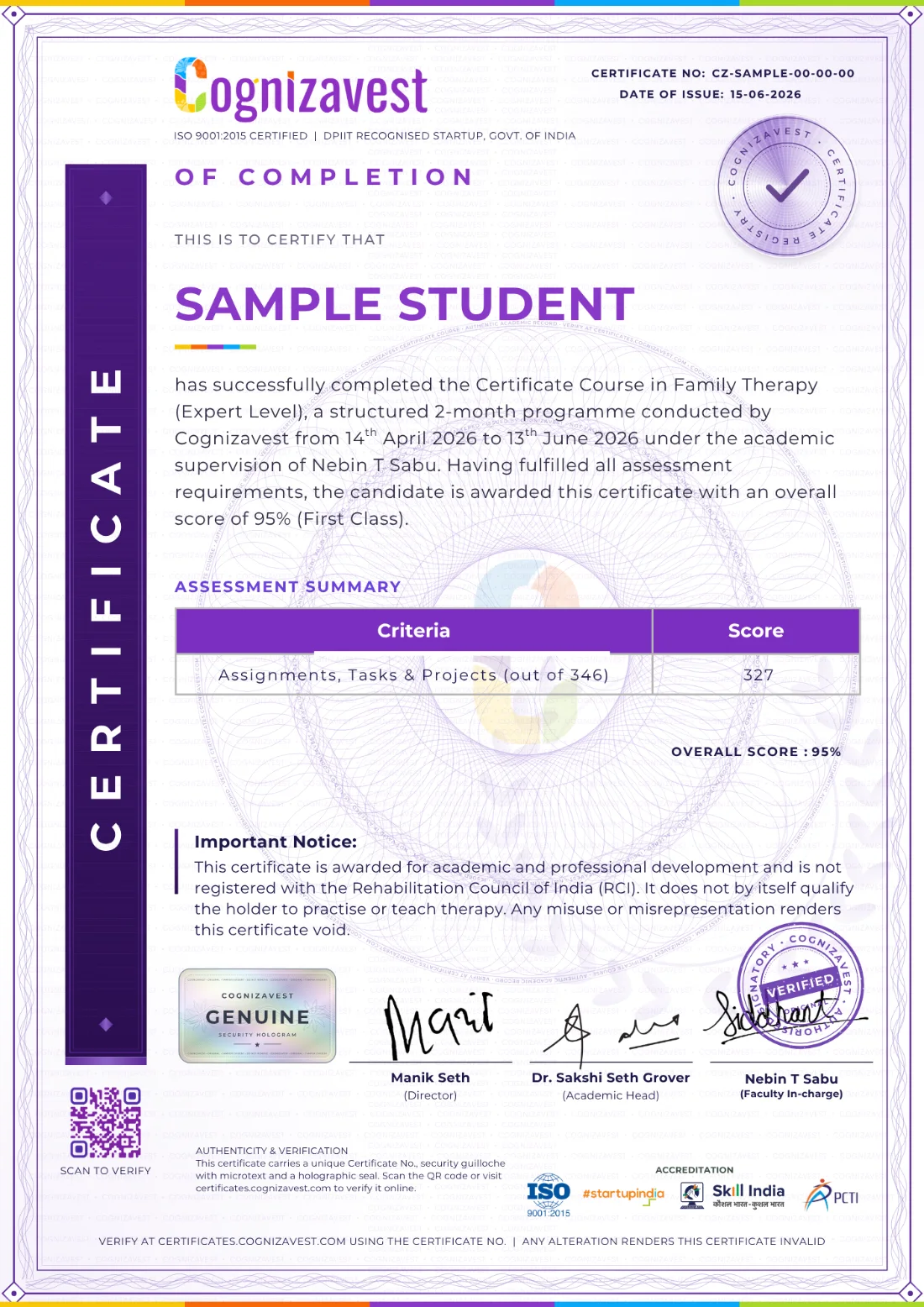
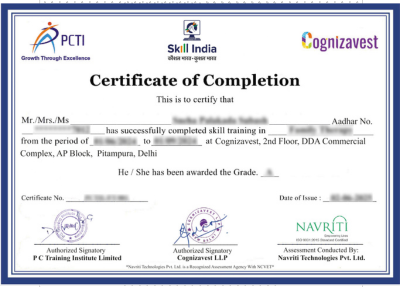
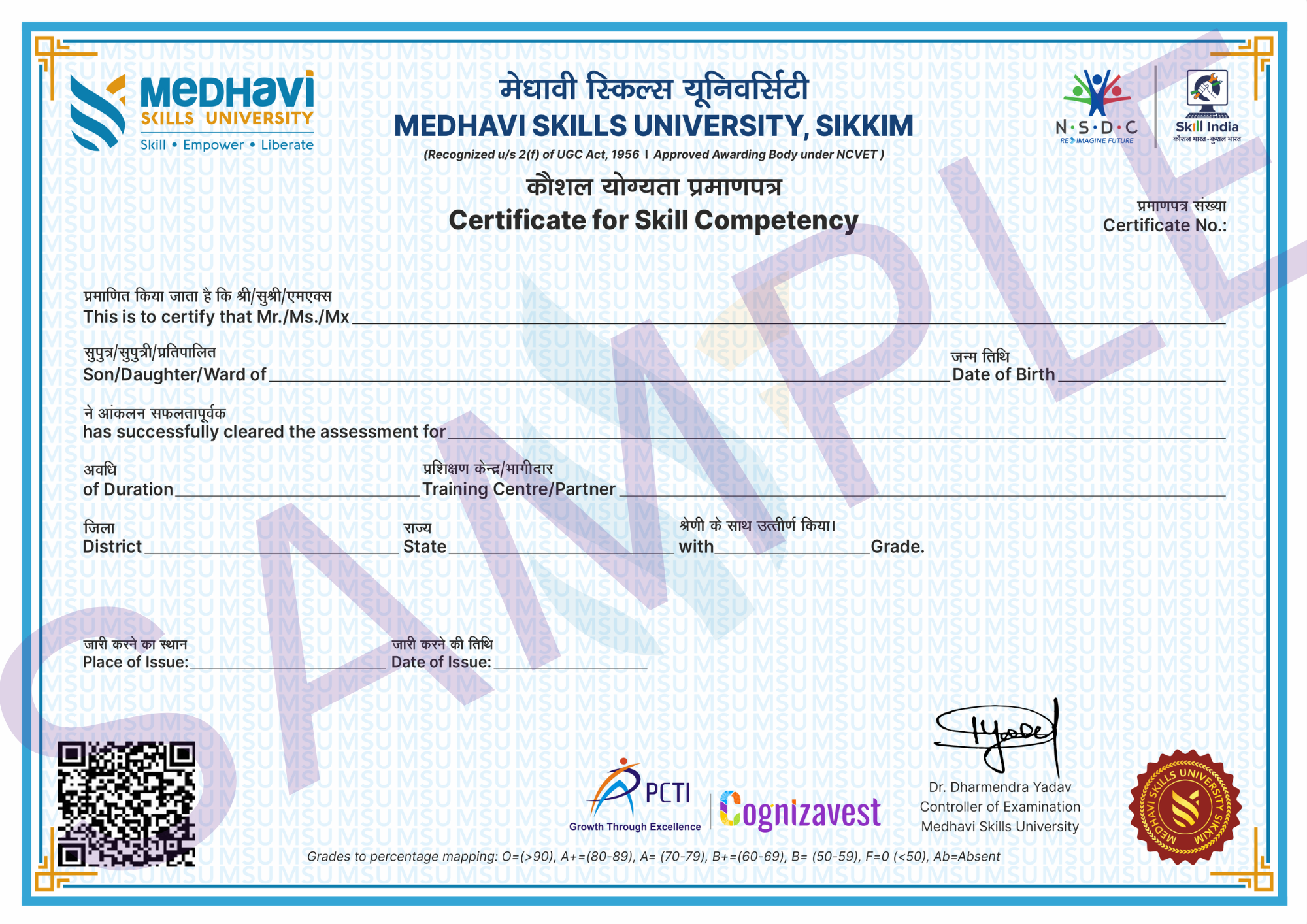
Make your learning visible.
Cognizavest certification is part of completion. Practitioner Level learners can add the NCVET Skill India certificate, and can also opt for a university certificate.
- 01Cognizavest certificate Included
Hardcopy certificate issued after fulfilling course requirements and completion review.
- 02NCVET Skill India certificate + ₹1,500
Optional add-on for Practitioner Level learners.
- 03University certificate + ₹2,500
Optional Certificate for Skill Competency issued by Medhavi Skills University after assessment. Practitioner Level; can be combined with NCVET.
Note: the Practitioner certificate is for Practitioner Level and Masters-qualified students. Add-on certificate fees (NCVET ₹1,500, university ₹2,500) are optional, not part of online checkout, and are collected separately by our team after you enroll.
Secure your seat with a clear plan.
Confirm your batch, choose your level, add resources if you want them, and check out.
Secure SSL checkout
Questions before you pay? Chat with us on WhatsApp
Everything to know before you enroll.
Tell us your background and we will suggest the right level.
Ask on WhatsAppWhat is de-addiction counselling?
De-addiction counselling is supportive, structured psychological help for people struggling with substance use (such as alcohol, tobacco, cannabis or opioids) or behavioral addictions (such as gaming or gambling). It focuses on motivation, triggers, cravings, relapse prevention, family support, risk awareness and timely referral for medical care when needed.
When does the next batch start?
The next De-addiction Counselling batch starts on 21 January 2027. Live online classes are held every Tuesday and Thursday from 5:00 PM to 6:00 PM IST.
Are the classes conducted live?
Yes. The Certificate Course in De-addiction Counselling is conducted through live online classes with interaction, discussion and trainer-led application.
What are the levels, duration and fees?
Beginner Level is 1 month at ₹2,999, Expert Level is 2 months at ₹4,999, and Practitioner Level is 3 months at ₹6,999. Levels are cumulative: Expert includes Beginner, and Practitioner includes all 12 modules.
Is there a payment plan?
Yes. Practitioner learners can pay ₹3,000 as the registration fee and then ₹2,000 + ₹2,000 in the monthly payment plan.
Does the course cover behavioral addictions too?
Yes. Alongside alcohol, tobacco, cannabis, opioids, stimulants, sedatives, inhalants and prescription misuse, the course covers behavioral addictions such as gaming, gambling, porn/sex, shopping and social media.
Who can join this course?
Psychology bachelor’s and master’s students or graduates, and professionals working in mental health and psychology who want addiction counselling readiness.
Who are the trainers?
The trainers are Ayesha Narmawala and Wasuddha Tikmani. Ayesha Narmawala is PGDRP (RCI CRR- A85502), M.A (Clinical Psychology), B.A (Psychology), with extensive experience in advanced diagnostics and therapeutic intervention. Wasuddha Tikmani is a Ph.D. Scholar, M.A. Clinical Psychology, B.A. Psychology, SET Qualified, with 3 years of experience.
Which certificates will I receive?
Every learner who completes the course requirements receives the Cognizavest certificate. Practitioner Level learners can add the NCVET Skill India certificate (₹1,500) and, as a third optional choice, a university Certificate for Skill Competency from Medhavi Skills University (₹2,500). Add-on fees are collected separately by our team after enrollment.
Does this course train me to provide detox or medication?
No. The course builds counsellor-level skills and is explicit about boundaries: withdrawal management, detox and medication are medical responsibilities, and the course teaches the red flags that need urgent medical or psychiatric referral. The certificate documents training and does not by itself authorise independent clinical practice.
What is the refund policy?
Cognizavest follows a strict no-refund policy for programs. Batch shifting may be considered only as per policy timeline and conditions.
Every lapse has a pattern. Learn to help clients break it.
Live classes every Tuesday and Thursday, 5–6 PM IST. Choose 1, 2 or 3 months.