



















Learn relationship counselling with theory, assessment and practical case formulation.
A 6-month live online diploma for learners who want to understand couple dynamics, family systems, attachment, communication patterns, relationship assessment, ethical referral and evidence-based relationship counselling models.
All key details before learners make the decision.
Batch date, timing, mode, papers, fees, trainers and certification details are kept clearly visible before enrollment.
Who can join this diploma.
This diploma is designed for learners who want relationship-focused counselling knowledge with ethical boundaries, assessment clarity and practical intervention understanding.
Psychology learners
Suitable for psychology students, graduates and postgraduates who want structured training in relationship, couple and family counselling concepts.
Helping professionals
Helpful for counselling, social work, education, community support and wellness-focused learners who work with interpersonal and family concerns.
Ethical boundaries
The diploma builds counselling process, assessment and referral readiness. High-risk concerns such as violence, coercive control or severe mental health risk require appropriate referral.
Relationship work needs more than advice. It needs assessment, systems thinking, emotional safety and repair planning.
Students learn to understand couple dynamics, family influence, attachment injuries, communication cycles, conflict patterns and ethical decision-making in relationship counselling.
Attachment and bonding
Understand adult attachment patterns, emotional safety, responsiveness, dependency, autonomy and attachment-based repair.
Couple and family systems
Explore marital dynamics, parent-child conflict, family-of-origin influence, intergenerational concerns and Indian family contexts.
Model-based practice
Learn Gottman-informed, EFT, CBT-behavioural, solution-focused, narrative, Bowenian and structural family applications.
From relationship intake to integrative case planning.
The diploma trains learners to think through relationship timelines, attachment patterns, communication cycles, family systems, ethical risk and evidence-informed intervention planning.
Relationship assessment begins with a clear relational map.
Learners explore intake, individual and dyadic information, relationship timelines, communication patterns, attachment assessment and risk screening before planning sessions.
From relationship concern to ethical counselling plan.
The diploma helps learners move step-by-step from intake and formulation to model selection, intervention sequencing, referral and termination planning.
Assess the relationship
Map the timeline, critical incidents, communication pattern, family-of-origin context, attachment concerns and safety flags.
Formulate the case
Use systemic, attachment-based, Gottman-informed, CBT-informed and relational schema lenses to define goals.
Choose interventions
Apply model-informed tools such as de-escalation, repair conversations, boundary maps, reframing and relationship worksheets.
Review and refer ethically
Document progress, identify risk, refer when needed and plan termination or next-step support responsibly.
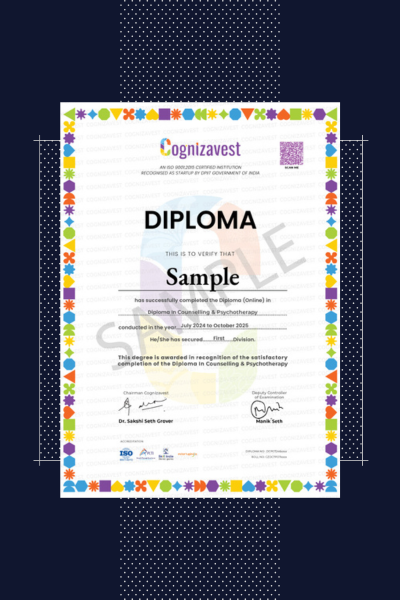
Earn a recognized diploma after successful completion.
The program includes Skill India / NCVET aligned certification positioning, examinations, practical completion requirements and hardcopy diploma documentation.
Designed for professional credibility
Hardcopy CertificateStudents complete live classes, assignments, case-based learning and assessments. Diploma documentation is processed after successful completion and result declaration.
Certificate that reflects structured learning.
Students receive diploma documentation after meeting attendance, practical and examination criteria.
- Skill India / NCVET aligned positioning
- Hardcopy diploma dispatch after completion
- Useful for academic and professional progression
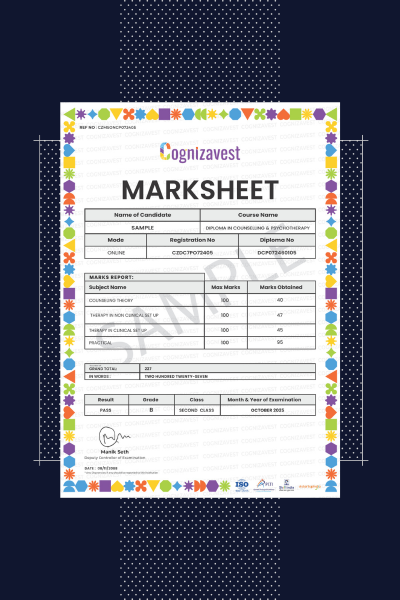
Assessment pathway with measurable criteria.
Students complete examinations and practicals to demonstrate learning and applied understanding.
- Minimum attendance requirement
- Practical and exam completion
- Result-linked diploma processing
A 6-paper diploma covering relationship foundations, assessment, models, family systems, ethics and advanced case application.
The syllabus builds from foundational theories to practical assessment, model-based interventions and professional readiness for relationship counselling.
- Professional Foundations
- Scope of relationship counselling and difference from therapy, coaching, guidance and advice
- Ethical foundations, confidentiality, informed consent, neutrality and multipartiality
- Contraindications and referral indicators
- Systems and Interpersonal Theories
- General Systems Theory, circular causality, feedback loops and relational homeostasis
- Interpersonal process theory and family-of-origin influence
- Bowenian and structural family concepts
- Attachment and Emotional Bonding
- Adult attachment patterns and internal working models
- Attachment injuries, emotional safety and co-regulation
- Dependency, autonomy, interdependence and emotional responsiveness
- Love, Commitment and Relational Meaning
- Sternberg’s Triangular Theory of Love, Social Exchange Theory and Equity Theory
- Commitment, investment and cultural scripts of relationships
- Indian context of love, marriage, family and gender roles
- Couple and Marital Dynamics
- Dating, premarital concerns, marital adjustment and emotional intimacy
- Physical intimacy concerns, jealousy, insecurity, trust rupture and infidelity
- Long-term dissatisfaction and separation ambiguity
- Gottman-Informed Dynamics
- Sound Relationship House, love maps and bids for connection
- Four Horsemen, repair attempts, flooding and gridlocked conflict
- Shared meaning, trust and commitment
- Family and Intergenerational Issues
- Parent-child conflict, sibling rivalry and adult child-parent boundaries
- In-law conflict, joint family issues and family loyalty versus autonomy
- Intergenerational value conflict and genogram-based understanding
- Social, Workplace and Contemporary Concerns
- Friendship rupture, workplace relational stress, people-pleasing and social rejection
- Long-distance, digital relationships, situationships and social media jealousy
- Intercultural, interfaith and LGBTQIA+ relationship sensitivity
- Intake and Relational Assessment
- Relationship intake format, individual and dyadic intake
- Relationship timeline, critical incidents and communication pattern assessment
- Attachment pattern, family-of-origin assessment and risk/safety screening
- Case Formulation
- 5P, systemic, attachment-based and Gottman-informed formulation
- CBT-informed and relational schema formulation
- Goal-setting in relationship counselling
- Counselling Micro-Skills and Process Skills
- Therapeutic alliance, balanced alliance, reflective responding and validation
- Circular questioning, reframing and de-escalation
- Managing blame, defensiveness and tracking interactional cycles
- Applied Relationship Counselling Tools
- Conflict cycle map, Four Horsemen worksheet and needs-expectations worksheet
- Boundary map, relationship timeline, genogram and trust reconstruction checklist
- Repair conversation template, decision clarity worksheet and couple check-in format
- Gottman Method-Based Interventions
- Assessment in Gottman Method and Sound Relationship House application
- Enhancing friendship system, managing conflict and dreams within conflict
- Building shared meaning, trust revival, commitment work and ethical limitations
- Emotion-Focused Couple Therapy
- EFT view of couple distress and negative interaction cycles
- Primary and secondary emotions, attachment needs and de-escalation
- Restructuring emotional responses and creating bonding events
- CBT and Behavioural Couple Approaches
- Cognitive distortions, attribution retraining and behaviour exchange
- Communication training, problem-solving training and behavioural agreements
- Cognitive restructuring and schema-informed couple work
- Solution-Focused and Narrative Approaches
- Scaling questions, exception-finding and preferred future
- Narrative externalization and deconstructing problem-saturated stories
- Re-authoring relationship narratives and meaning-making after rupture
- Bowenian and Structural Family Applications
- Differentiation of self, emotional fusion, triangulation and multigenerational transmission
- Family projection process, enmeshment and disengagement
- Hierarchies, subsystems and boundary restructuring
- Attachment-Based Relationship Counselling
- Attachment injuries, ruptures, emotional safety and fears of abandonment or engulfment
- Pursuer-withdrawer cycle and attachment-based repair
- Corrective emotional experiences in relationship counselling
- Indian and Collectivistic Contexts
- Joint family systems, family approval, marital choice and gendered expectations
- Duty, guilt, obligation, autonomy, divorce stigma and cultural humility
- Working with family involvement ethically
- Specialized Relationship Contexts
- Breakup, separation, infidelity recovery and co-parenting after separation
- Blended families, illness, caregiving strain and infertility-related stress
- Grief, career strain, anxiety, depression, addiction or trauma history in relationship distress
- Integrative Case Conceptualization
- Combining systemic, attachment, Gottman, CBT and narrative lenses
- Identifying maintaining factors and counselling goal hierarchy
- Session planning and intervention sequencing
- Advanced Relationship Counselling Practice
- High-conflict couples, emotionally distant couples and repeated rupture-repair failure
- Trust reconstruction, family boundary and parent-child relational cases
- Workplace relational stress and ambivalent separation cases
- Ethics, Risk and Referral in Advanced Cases
- Coercive control, emotional abuse, domestic violence risk and self-harm/suicide risk
- Psychiatric, trauma therapy, couple therapy and legal referral
- Documentation of risk/referral and ethical termination
- Professional Practice and Case Presentation
- Case documentation, session notes, relationship counselling plan and progress review
- Termination planning, professional identity and supervision needs
- Referral network development and final integrative case presentation
Learning support inside the program.
The diploma is built for live online learning with structured classes, assignments, discussion-based learning and module-wise progression.
Support included
- Structured 6-paper syllabus
- Relationship counselling tools and worksheets
- Case formulation and model-based learning
- Ethics, risk and referral clarity
- Hardcopy study material and diploma documentation
Learn from trainers experienced in counselling and applied psychology.
Trainer details are added for the current batch. Faculty may be updated as per academic scheduling requirements.

Ayesha Narmawala
PGDRP (Post graduate diploma in Rehabilitation Psychology) (RCI CRR- A85502), M.A. Clinical Psychology, B.A. Psychology. 4+ Years of Experience.

Shreya Dhasmana
M.A. Applied Psychology, B.A. Hons. Sociology, PG Diploma in Guidance & Counseling. Trainer for applied psychology, counselling and therapy-oriented learning.
By the end, learners understand relationship counselling through practical and ethical lenses.
The diploma focuses on theory clarity, assessment, model-informed counselling tools, family systems, referral readiness and case presentation.
Assess relational patterns
Understand relationship timelines, critical incidents, communication patterns, attachment styles and family-of-origin context.
Formulate with models
Use systemic, attachment, Gottman-informed, CBT-informed and narrative lenses for case conceptualization.
Use practical tools
Apply conflict cycle maps, boundary maps, repair conversation templates, genograms and decision clarity worksheets.
Work ethically
Identify coercive control, emotional abuse, domestic violence risk, self-harm risk and referral indicators.
Built for structured applied learning.
Students move from foundational theory to advanced relationship case application through 6 papers, case discussions, worksheets and practical learning.
Topics you will repeatedly engage with
Relationship counselling learning integrates individual, couple, family and social context.
Choose your registration plan.
Select the monthly payment plan or full course fee option. Checkout uses the WooCommerce product IDs provided for this diploma.
Diploma in Relationship Counseling
Live online diploma with 6 papers covering relationship foundations, couple and family dynamics, assessment, counselling models, advanced contexts and professional practice.
- Classes on Wednesday and Friday, 6 PM – 7 PM
- Online examinations and practical requirements
- Hardcopy study material and diploma documentation
- Relationship counselling tools, ethics and referral readiness
Everything learners usually ask before enrolling.
Course format, eligibility, syllabus, payment and completion information are grouped for quick review.
Are the classes conducted live? +
Yes. Classes are conducted live online through Google Meet, and recordings may be provided for reference according to program communication.
Who can enroll in this diploma? +
This diploma is suitable for psychology learners and allied helping professionals interested in relationship, couple, family and interpersonal counselling work.
Does this program teach relationship counselling models? +
Yes. The syllabus includes Gottman-informed, EFT, CBT-behavioural, solution-focused, narrative, Bowenian and structural family applications.
Will my diploma have recognition? +
The program includes Skill India / NCVET aligned certification positioning and diploma documentation after successful completion.
How many papers are included? +
The diploma includes 6 papers covering foundations, couple/family dynamics, assessment, evidence-based models, advanced systems/contextual work and professional practice.
Are Indian relationship contexts covered? +
Yes. The syllabus includes Indian and collectivistic contexts, joint family systems, family approval, marital choice, gendered expectations, divorce stigma and family involvement.
Will relationship tools be covered? +
Yes. Tools include conflict cycle maps, Four Horsemen worksheet, boundary map, relationship timeline, genogram, trust reconstruction checklist and repair conversation template.
Are risk and referral topics included? +
Yes. Advanced papers include coercive control, emotional abuse, domestic violence risk, self-harm risk, referral documentation and ethical termination.
What are the fee options? +
The monthly payment plan is ₹18,000. The full course fee option is ₹17,000.
What is the class timing? +
Classes are scheduled on Wednesday and Friday from 6 PM to 7 PM.
When does the batch start? +
The batch starts on 24th June 2026.
Will I get hardcopy study material and diploma documentation? +
Yes. The program includes hardcopy study material and diploma documentation after successful completion.
Start your relationship counselling diploma journey.
Join the live online batch starting 24th June 2026 and build a structured foundation in relationship assessment, couple and family dynamics, counselling models, ethics and professional case application.
