









Certificate Course in Neuropsychology · 2 levelsEvery behaviour has an address in the brain.
A live, online neuropsychology course that connects brain anatomy, neurons and the lobes with real behaviour, then goes further into neuroplasticity, lateralization and the neuropsychological profiles of dementia, schizophrenia, mood and substance use disorders.
Simplified for learning: real behaviour always draws on networks across the whole brain.
Send a signal from one neuron to the next.
Set the stimulus, choose healthy or damaged myelin, and fire. Watch an electrical impulse become a chemical message across the synapse.
Neurons talk in two languages: an electrical impulse inside the cell, and a chemical message between cells.
One brain, four ways of looking inside it.
Switch the scanner. Each method answers a different question about the living brain.
Read the behaviour. Find the brain area.
Six short teaching cases. Read each one, then tap the part of the brain you think is most involved.
Simplified teaching cases for understanding brain–behaviour links. The course builds conceptual and case-based understanding, not diagnostic training.
Left brain, right brain: science or myth?
Send each statement to the hemisphere that leads, or call it a myth. The two halves light up as you answer.
Practice rewires the brain. So can recovery.
Practise a new skill and watch the pathway strengthen. Then simulate an injury and see how practice builds a detour.
Each time you practise, the same neurons fire together and their connections grow stronger.
How conditions show up in thinking, not just in mood.
Tap a condition to see which cognitive domains it commonly touches, and the brain systems involved.
Often affected Can be affected
General patterns for conceptual understanding. Profiles vary from person to person, and diagnosis is made by qualified clinicians.
Two levels. Foundations first, then clinical depth.
Advanced includes everything in Beginner. Fees include taxes.
Beginner
45+ hours · 1 credit course
Modules A–D of 7
- Introduction to neuropsychology and methods of studying the brain
- Neurons, supporting cells and neural communication
- Anatomy of the brain and its major divisions
- Frontal, temporal, parietal and occipital lobes and their syndromes
Advanced
Everything in Beginner, plus 9+ case discussions
All 7 modules
- Neuroplasticity in learning, recovery and injury
- Brain lateralization and split-brain research
- Profiles of dementia, schizophrenia, mood and substance use disorders
- 2 credit course · optional NCVET (+₹1,500) and university (+₹2,500) certificates
Seven modules. From a single neuron to a clinical profile.
The full neuropsychology syllabus, level by level. Filter to see exactly what your fee includes.
Beginner Level · 2 months · 45+ hours
AIntroduction to Neuropsychology5 topics
- What is neuropsychology?
- Scope and relevance in understanding human behavior
- Neuropsychology vs psychology vs neuroscience
- Information processing approach
- Methods of studying the brain: CT, MRI, fMRI, PET, scans, behavioral correlation and animal-study ethics overview
BNervous System Foundations4 topics
- Neurons and supporting cells
- Communication within neurons
- Communication between neurons
- Neurotransmission as a conceptual foundation
CAnatomy of the Brain3 topics
- Major anatomical divisions
- Subdivisions of the brain
- Structure and function of categorical divisions
DLobes of the Brain & Syndromes4 topics
- Frontal lobe: executive and behavioral syndromes
- Temporal lobe: memory and emotional processing
- Parietal lobe: perception and integration
- Occipital lobe: visual processing
Advanced Level · 3 months · adds 9+ case discussions
EBasics of Neuroplasticity3 topics
- What is neuroplasticity?
- Role of plasticity in learning and recovery
- Plasticity after injury as a conceptual understanding
FBrain Lateralization4 topics
- Left vs right hemisphere differences
- Functional specialization
- Split-brain research highlights
- Clinical implications of lateralization
GNeuropsychological Profiles of Conditions5 topics
- Dementia
- Schizophrenia
- Mood disorders
- Substance Use Disorders
- Conceptual and case-based understanding, not diagnostic training
From memorising brain parts to thinking like a neuropsychologist.
Cognizavest community. Alumni get access to events, supervision programs and offline community meet-ups across India.
Who should join this cohort?
Tap the description closest to you.
This certificate builds conceptual and case-based understanding of neuropsychology. It does not train learners to diagnose, and rehabilitation work is discussed in the context of appropriate supervision.
Learn from experienced psychologists.
Tap a card to meet each trainer.
Learners loved the brain–behaviour clarity.
Reflections from learners in earlier neuropsychology cohorts.
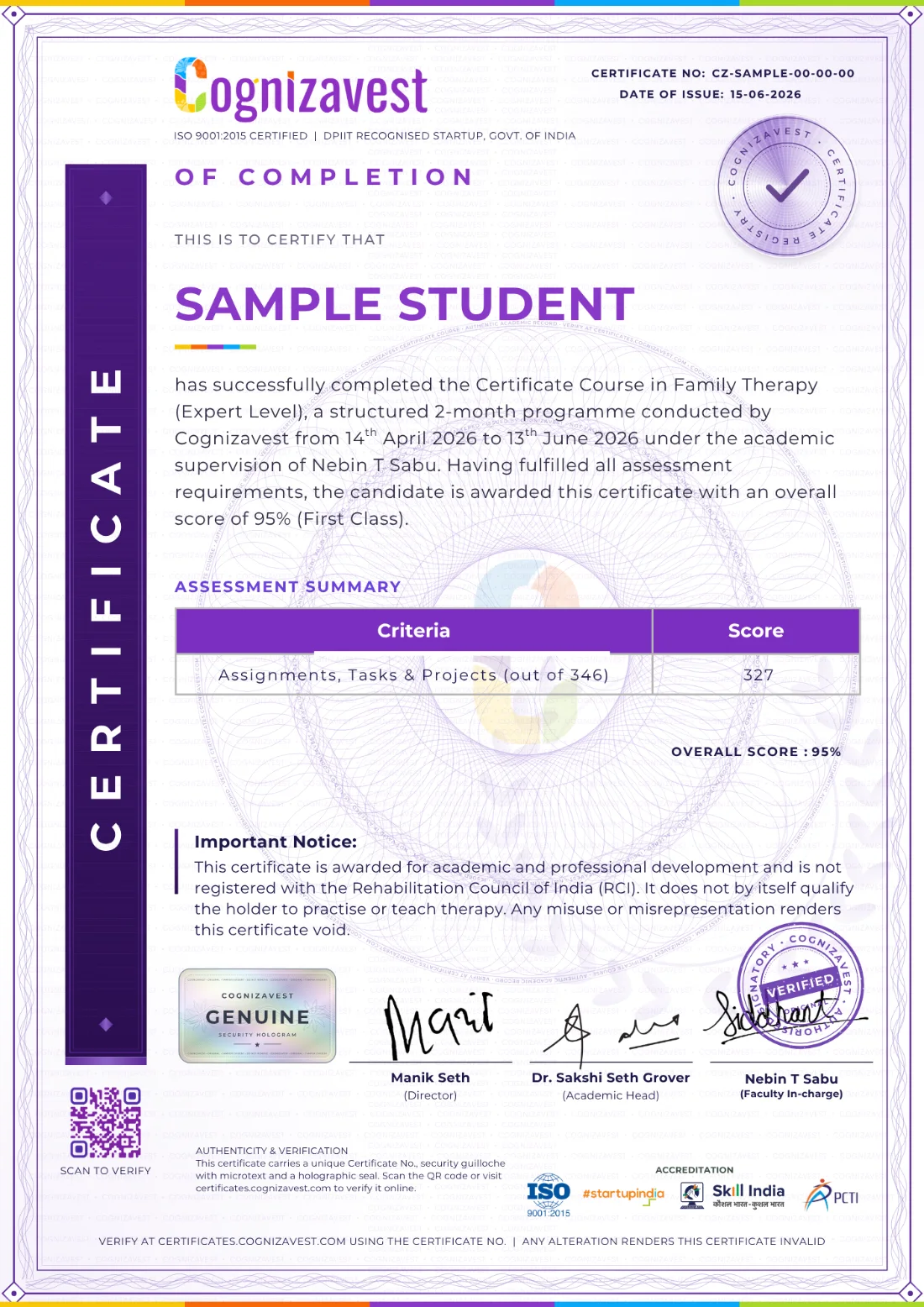
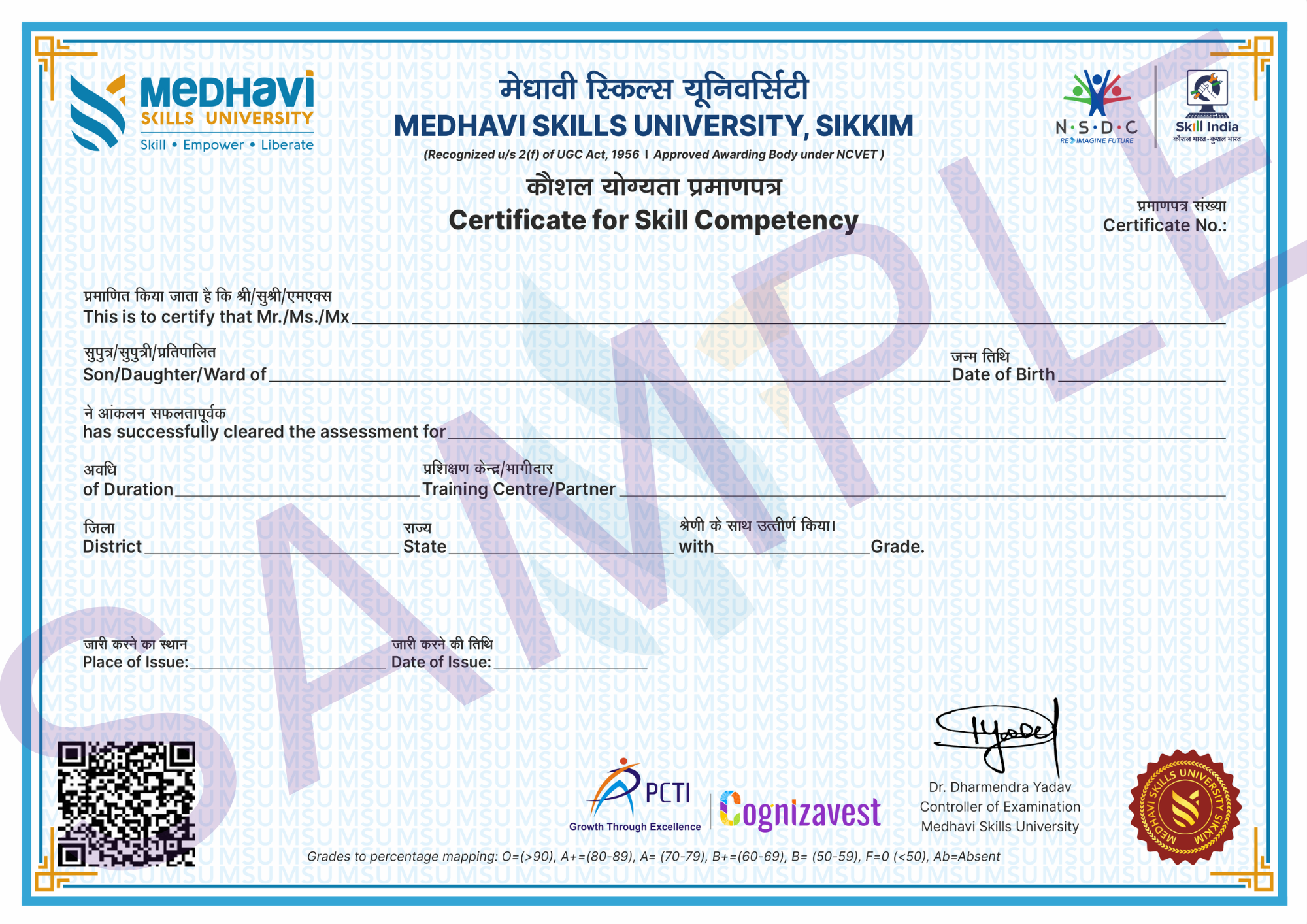
Make your neuropsychology learning visible on your profile.
A Cognizavest hardcopy certificate at both levels. At Advanced Level you can add the NCVET Skill India certificate, and can also opt for a university certificate.
- 01Cognizavest certificate Included
Hardcopy certificate for Beginner or Advanced Level, issued after course requirements and completion review.
- 02NCVET Skill India certificate + ₹1,500
Optional add-on at Advanced Level, opted for separately through enrollment support.
- 03University certificate + ₹2,500
Optional Certificate for Skill Competency issued by Medhavi Skills University after assessment, at Advanced Level. Can be combined with NCVET.
Note: add-on certificate fees (NCVET ₹1,500, university ₹2,500) are optional, not part of online checkout, and are collected separately by our team after you enroll.
Secure your seat in the January batch.
Confirm the batch, choose your level, add resources if you want them, and check out.
This page has 6 brain experiments. The course turns them into live, case-based classes.
Secure SSL checkout
Questions before you pay? Chat with us on WhatsApp
Everything to know before you enroll.
Tell us your background and goals, and we will help you choose.
Ask on WhatsAppWhat is neuropsychology?
Neuropsychology studies how the brain and nervous system relate to thinking, emotion and behaviour. It connects brain structures and functions, such as the frontal, temporal, parietal and occipital lobes, with abilities like memory, attention, language and planning, and with how these change in clinical conditions.
Is this neuropsychology course online?
Yes. The course is conducted through live online classes on Google Meet with recording access as per program policy.
When does the next batch start?
The new batch starts on 28th January 2027. Classes are scheduled on Tuesday and Thursday from 6 PM to 7 PM IST.
What are the available levels and fees?
There are two levels: Beginner Level (2 months, ₹3,999) and Advanced Level (3 months, ₹6,499). Both include 45+ hours of training, and Advanced includes everything in Beginner. Fees include taxes.
What will I learn in Beginner Level?
Beginner Level covers an introduction to neuropsychology and methods of studying the brain (CT, MRI, fMRI, PET), nervous system foundations, brain anatomy, and the lobes of the brain with related syndromes.
What is added in Advanced Level?
Advanced Level includes Beginner content and adds neuroplasticity, brain lateralization and split-brain research, and neuropsychological profiles of conditions such as dementia, schizophrenia, mood disorders and substance use disorders, with 9+ case discussions.
Who can enroll?
Learners currently pursuing or who have completed a bachelor’s or master’s degree, and mental health, education and rehabilitation professionals who want clearer neuropsychological literacy.
Does this course train me to diagnose?
No. The course builds conceptual and case-based understanding of brain–behaviour relationships and condition profiles. Diagnosis is made by qualified clinicians, and rehabilitation work is discussed in the context of appropriate supervision.
Who are the trainers?
Dr. Sakshi Seth Grover (PhD in Psychology; PGDRP, RCI CRR-A118591; 11+ years of experience) and Gunja Bhatt (Ph.D. Scholar; M.A. Clinical Psychology; B.A. Psychology; SET Qualified; 3 years of experience).
What certification is included?
A Cognizavest hardcopy certificate at both levels after course requirements are met. At Advanced Level you can add the NCVET Skill India certificate (₹1,500) and, as a third optional choice, a university Certificate for Skill Competency from Medhavi Skills University (₹2,500). Add-on fees are collected separately by our team after enrollment.
Can I add hardcopy notes or a diary?
Yes. Hardcopy Notes (₹499) are available as an optional add-on during checkout, and the Diary (Premium Matte Notebook) is ₹199, or just ₹99 when you add Hardcopy Notes.
What is the refund policy?
Cognizavest follows a strict no-refund policy for programs. Batch shifting may be considered only as per policy timeline and conditions.
See the brain behind every behaviour.
Live classes every Tuesday and Thursday, 6–7 PM IST. Beginner ₹3,999 · Advanced ₹6,499.