Every admission season, students pay fees for a “clinical psychology” programme and later discover the institute was not approved by the Rehabilitation Council of India (RCI) for that course or that year. The Council itself now carries a notice on its homepage asking prospective students to check an institute’s approval status before admission. This guide shows how to do that check in a few minutes, what the new 2026 course names mean, and which red flags to watch for.
Why does RCI approval matter?
RCI regulates training for rehabilitation professionals in India, including clinical psychologists and rehabilitation psychologists. On its regular-mode courses page, the Council advises candidates to seek admission only in RCI-recognised institutions and states that a rehabilitation qualification obtained from an institution not recognised by RCI is not valid for employment or practice.
In practical terms, if you want to become a clinical psychologist in India, your professional programme must be RCI-approved at that institute, for that course, for your batch. A general M.A. or M.Sc. in Psychology is a valuable degree, but on its own it does not lead to RCI registration as a clinical psychologist.
What are the new RCI course names?
An RCI office memorandum dated 3 May 2026, based on a decision of the 48th General Council meeting, changed the names of clinical and rehabilitation psychology courses:
| Old name | New name |
|---|---|
| B.Sc. Clinical Psychology | Bachelor in Clinical Psychology (B.Clin. Psy) |
| B.Sc. Rehabilitation Psychology | Bachelor in Rehabilitation Psychology (B.Rehab. Psy) |
| M.A. Clinical Psychology | Master in Clinical Psychology (M.Clin. Psy) |
| M.A. Rehabilitation Psychology | Master in Rehabilitation Psychology (M.Rehab. Psy) |
The two-year master’s programme is the professional route that replaced the older M.Phil. in Clinical Psychology. Because institutes may still advertise under older names, match the course in the RCI list rather than relying on the brochure title. If you are comparing regulators, our RCI vs NCAHP guide explains who covers which psychologists.
How do you check if an institute is RCI-approved?
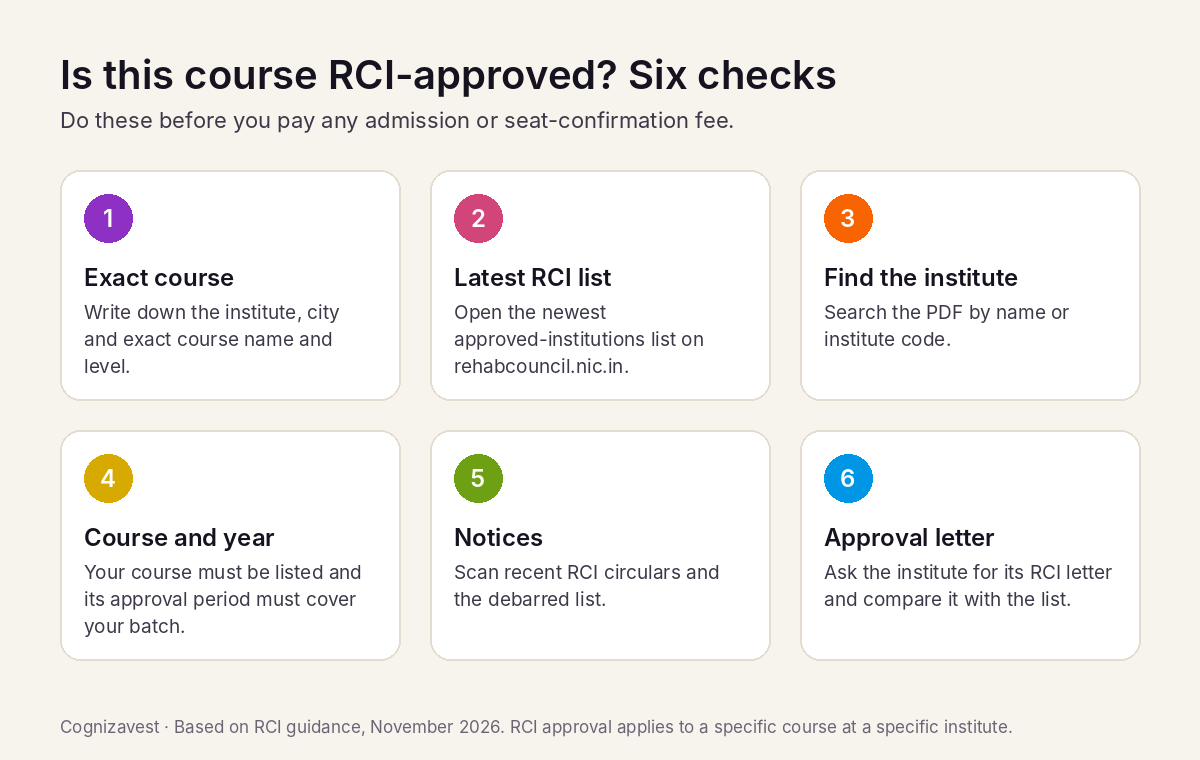
- Write down the exact details. Note the institute’s full name, its city and the exact course name and level you are applying for.
- Open the official list. Go to rehabcouncil.nic.in and open the approved institutions list for regular-mode courses. RCI updates this list during the year, so use the most recent file, not a screenshot shared on social media.
- Search for the institute. Use your browser’s find function to search the PDF by institute name or institute code. Each entry shows the approved training programme, the approval period and the sanctioned intake.
- Match the course and the year. Check that your exact course is listed for that institute, and that the approval period covers the session you are joining. Note any mention of conditional approval.
- Check notices and the debarred list. RCI publishes circulars and lists of institutes that are debarred or removed. Scan the latest circulars on the RCI website before paying.
- Ask for the approval letter. A genuine institute can show its RCI approval for the course and session. Compare the letter with the RCI list.
What are the red flags?
- “RCI-approved” with no course named. RCI approves specific programmes at specific institutes, not an institute’s entire catalogue.
- Short online courses claiming RCI approval. Skill-based certificate courses, including ours at Cognizavest, are professional training. They are not RCI-approved programmes and do not lead to RCI registration.
- Approval periods that end before your course does. If the listed approval ends during your batch, ask the institute in writing how it will be extended.
- Pressure to pay quickly. A seat that cannot wait two days for a check on the official list is a seat worth walking away from.
What about counselling and other psychology careers?
Not every psychology career runs through RCI. Counselling, school, organisational and health psychologists who are not clinical psychologists fall under the National Commission for Allied and Healthcare Professions (NCAHP), which notified its registration regulations in 2026. Read our explainer on the NCAHP draft provisional registration rules for the latest on that route.
Whichever route you take, practical training still matters. Many students add supervised practice and skills training alongside their degree, for example through a training-based psychology internship. Just be clear that such training builds skills and does not replace an RCI-approved professional programme.
Frequently asked questions
Where is the official list of RCI-approved institutes?
On the Rehabilitation Council of India website, rehabcouncil.nic.in, under the approved institutions for regular-mode courses. Always use the latest version of the list.
Is M.Clin.Psy the same as M.Phil. Clinical Psychology?
The two-year Master in Clinical Psychology (M.Clin. Psy) is the professional programme that replaced the M.Phil. route. The name changed from M.A. Clinical Psychology in May 2026.
Can I become a clinical psychologist with an online course?
No. You need an RCI-approved professional programme from an approved institute, followed by registration with RCI.
Does an institute’s university recognition mean RCI approval?
No. A university can be recognised by UGC and still need separate RCI approval for each professional rehabilitation course it runs.
What should I do if my institute is not on the list?
Ask the institute for its RCI approval letter for your course and session, and confirm the details with RCI before paying fees.