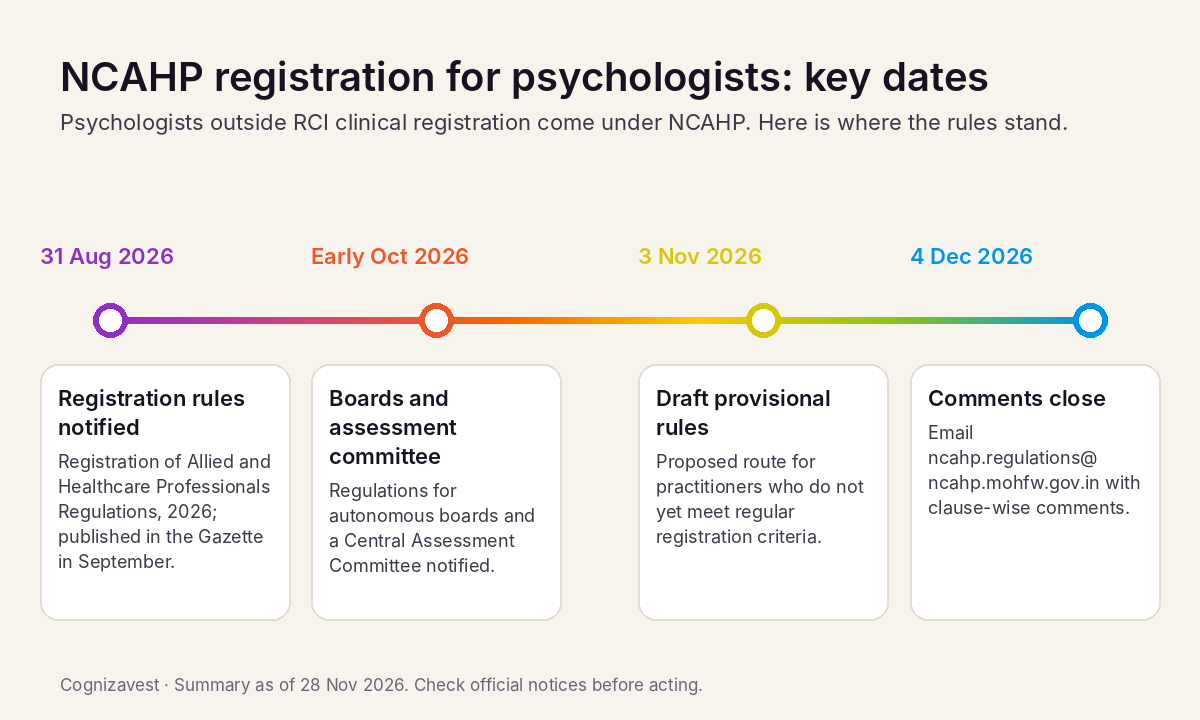
If you practise as a psychologist or counsellor in India without RCI registration, the next few weeks matter. On 3 November 2026 the National Commission for Allied and Healthcare Professions (NCAHP) released draft rules for provisional registration, the route meant for people already working in an allied or healthcare profession who do not meet the full registration criteria. Public comments are open until 4 December 2026. This guide explains what has been notified so far, what the draft proposes, what is still unclear for psychologists, and what you can do now.
This is a plain-language summary based on official notices and news reports available on 28 November 2026. Always read the official documents on the NCAHP website before making decisions. It is not legal advice.
What has NCAHP already notified for psychologists?
The NCAHP was set up under the National Commission for Allied and Healthcare Professions Act, 2021. Its main registration rules, the Registration of Allied and Healthcare Professionals Regulations, 2026, are dated 31 August 2026 and were published in the Gazette of India in September 2026.
- Psychologists are a recognised profession. The official enrolment portal lists “Psychologist (Except Clinical Psychologist covered under RCI for PWD)” among allied and healthcare professions, under Behavioural Health Sciences.
- Clinical psychologists stay with RCI. Clinical psychologists who are eligible to register with the Rehabilitation Council of India are not covered by NCAHP registration. Our RCI vs NCAHP explainer covers the difference in detail.
- Registration is renewable. As reported, registration is valid for five years and must then be renewed.
- Continuing education is built in. As reported, registered professionals must complete at least 15 hours of continuing professional development (CPD) a year, and no more than half of those hours may be online.
- Registration runs through state councils. Applications go to the State Allied and Healthcare Council, which forwards details to the central register. Where a state council is not yet functional, the regulations provide an alternative route through the Commission.
By early October 2026 NCAHP had also notified regulations setting up autonomous boards and a Central Assessment Committee. As of late November 2026 we could not find an official notice saying that regular registration of psychologists has opened, so check the NCAHP website for the current status.
What is provisional registration?
Regular registration is for people whose qualification and experience match the recognised list for their profession. Many people in India have been working for years with older or non-standard qualifications. Provisional registration is the proposed bridge for them: a time-limited registration that lets an eligible practitioner keep working while they upgrade to the standard needed for regular registration.
What does the draft propose?
The draft is titled Draft Provisional Registration of Allied and Healthcare Professionals Regulations, 2026. Based on the official announcement and news coverage, the main proposals are:
- An online system for applications, credential checks and certificates, with each provisionally registered professional receiving a Provisional Registration Unique Identification Number (PR UID).
- Bridge courses for skill upgradation, reported as lasting six months to one year, with supervised clinical training, offered through recognised allied and healthcare institutions. Reports say bridge courses upgrade skills but do not award a new degree or diploma.
- Qualifying examinations, where applicable, before moving from provisional to regular registration.
- Time limits. Reports describe a two-year window to apply after the regulations commence and a three-year grace period for practitioners with older qualifications.
- Fees reported as Rs 2,000 to apply, Rs 5,000 for an appeal and Rs 1,000 for a one-year extension.
- Residence. Applicants are reported to need to live in the state where they apply.
- Appeals against rejection, with a written decision and a chance to be heard.
These details come from the draft as reported. They can change before the final regulations are notified.
What is still unclear for psychologists?
Most coverage of the draft gives examples such as physiotherapists, laboratory technologists and optometrists. We could not find reporting that explains exactly how the provisional route will apply to psychologists. Questions worth watching, and worth raising in your comments, include:
- Will practitioners with a one-year master’s degree, a distance or online degree, or a postgraduate diploma qualify for provisional registration?
- What will count as experience, and how should it be proved for people in private practice, schools, NGOs or online counselling?
- What will psychology bridge courses contain, and which institutions will offer them?
- How will the competency examination work for psychologists?
Is enrolling on the AHPR portal the same as registering?
No. The Allied and Healthcare Professionals enrolment portal (ahpr.abdm.gov.in) states that enrolment is for national data collection and is not registration. Registration happens through the process set out in the regulations, ending with your name on the state and central registers and a unique identification number. Enrolling is free and can still be useful, but it does not by itself let you call yourself a registered psychologist.
How can you comment on the draft?
- Download the draft from the NCAHP website (ncahp.abdm.gov.in) and read the sections on eligibility, bridge courses and examinations.
- Write specific, clause-by-clause comments. Explain your situation, for example “I hold a one-year M.A. in Counselling Psychology and have practised in a school for six years”.
- Email your comments to [email protected] before 4 December 2026.
Comments are invited from professionals, associations, educational institutions, state councils, healthcare institutions, experts and the public.
What should you do now?
- Organise your documents. Keep degree certificates, mark sheets, proof of course mode and duration, and proof of work experience together.
- Start a CPD log. Record trainings, workshops and supervision with dates and hours. Since the regulations expect yearly CPD, a log will help at renewal time.
- Check your state council. Find out whether your State Allied and Healthcare Council is functioning and how it will accept applications.
- Be careful with shortcuts. Be wary of anyone promising guaranteed registration for a fee. Only the state council and the Commission can grant registration.
Where do short courses fit in?
Skill-based certificate and diploma courses, including ours at Cognizavest, are professional training. They are not degrees, they are not listed qualifications for registration, and they do not give you NCAHP or RCI registration. What they can do is build practical skills, such as case formulation and counselling techniques, and support your ongoing learning. NCAHP has not yet published which kinds of training will count towards CPD hours, so keep certificates and check the final rules.
Frequently asked questions
Do RCI-registered clinical psychologists need NCAHP registration?
No. Clinical psychologists who are eligible to register with RCI are excluded from NCAHP’s psychologist category and continue with RCI. If you are choosing a clinical programme, here is how to check if a course is RCI-approved.
Has NCAHP registration for psychologists started?
The registration regulations were notified in August 2026. As of late November 2026 we could not find an official notice that regular registration of psychologists has opened. Watch the NCAHP website and your state council.
Is the provisional registration draft final?
No. It is a draft open for comments until 4 December 2026. The final version may differ.
Can counsellors register under NCAHP?
The recognised category is “Psychologist”, with qualifications listed in the regulations. Whether a particular counselling qualification is accepted depends on that list, so check the schedule in the official regulations or ask your state council.
Do online courses count for CPD?
As reported, no more than half of the yearly CPD hours may be online. NCAHP has not yet published detailed rules on which providers or formats qualify.
Sources
- NCAHP, Registration of Allied and Healthcare Professionals Regulations, 2026 (ncahp.abdm.gov.in)
- DD News, 11 November 2026: NCAHP proposes new registration framework
- Allied and Healthcare Professionals Enrolment Portal and FAQ
- Careers360, 16 September 2026: NCAHP makes registration, annual training must
- Telangana Today, 11 November 2026: draft provisional registration
- ThePrint: allied and healthcare regulations notified