












Somewhere in almost every psychology degree in India sits a line that makes students nervous: “Candidates must complete an internship of the prescribed number of hours.” For many programmes that number is 120 or 240 hours. The hours themselves are rarely the hard part. What trips students up is planning them around semesters, finding a placement that actually teaches something, and then proving the work in a format their university will accept.
This guide is the planner we wish every student had in their first year. It covers what a 240-hour psychology internship should include, how to schedule it without burning out, how to keep records that hold up at submission time, and the questions to ask before you pay any provider, including us.
What is a 240-hour psychology internship?
A 240-hour internship is a supervised block of practical training, usually completed over six to ten weeks. In psychology it typically combines learning sessions, case discussions, observation, roleplays or supervised practice, and written work such as case histories and reflective notes.
Universities set hour requirements in different ways. Some ask for a fixed number of hours in one setting, some allow hours to be split across placements, and some specify the kind of work that counts. That is why the single most important step comes before you enrol anywhere.
Step 1: Read your university’s requirement first
Before you choose a provider, find your programme’s internship guidelines (often in the programme guide, practicum handbook or a notice from your department) and write down five things:
- Total hours required and whether they can be split.
- Allowed settings: hospital, clinic, NGO, school, organisation, or online training.
- Supervisor requirements: qualification, designation, and whether they must sign every page.
- Documents to submit: certificate, attendance sheet, logbook, case reports, report format and word count.
- Deadline for submission and any viva or presentation.
If anything is unclear, email your coordinator and keep the reply. A one-line confirmation in writing can save you from repeating 240 hours.
Step 2: Choose the right setting and track
Match the internship to the career you are moving towards, not just to the hour count.
| If you want to work in… | Look for a track focused on… | Core skills you should leave with |
|---|---|---|
| Clinical settings | Clinical psychology | Case history, mental status examination (MSE), psychopathology, case formulation |
| Counselling and therapy | Counselling psychology | Rapport, active listening, session structure, ethics and referral |
| Schools and child services | Child psychology | Developmental milestones, observation, parent communication |
| HR, workplaces, L&D | Organisational psychology | Assessment, employee wellbeing, training design |
Online internships suit students who study or work during the day and cannot travel to a hospital. Offline placements give more direct exposure. Many students combine both: an online track for structured skills and supervision, and a shorter field placement for real-world observation. Our earlier guide on choosing an online psychology internship in India compares the two in more detail.
Step 3: Plan your 240 hours on a calendar
240 hours sounds enormous until you divide it. Here are three realistic paces:
- Intensive (about 6 weeks): 40 hours a week. Works in summer or winter breaks only.
- Balanced (about 8 weeks): 30 hours a week. Manageable alongside light coursework.
- Steady (10 to 12 weeks): 20 to 24 hours a week. Best during a regular semester.
Count everything your provider and university treat as internship work: live sessions, case labs, assigned readings and assessments, supervised roleplays, case write-ups and reflective journaling. Then block it into your week the way you would block classes, and protect the slots.
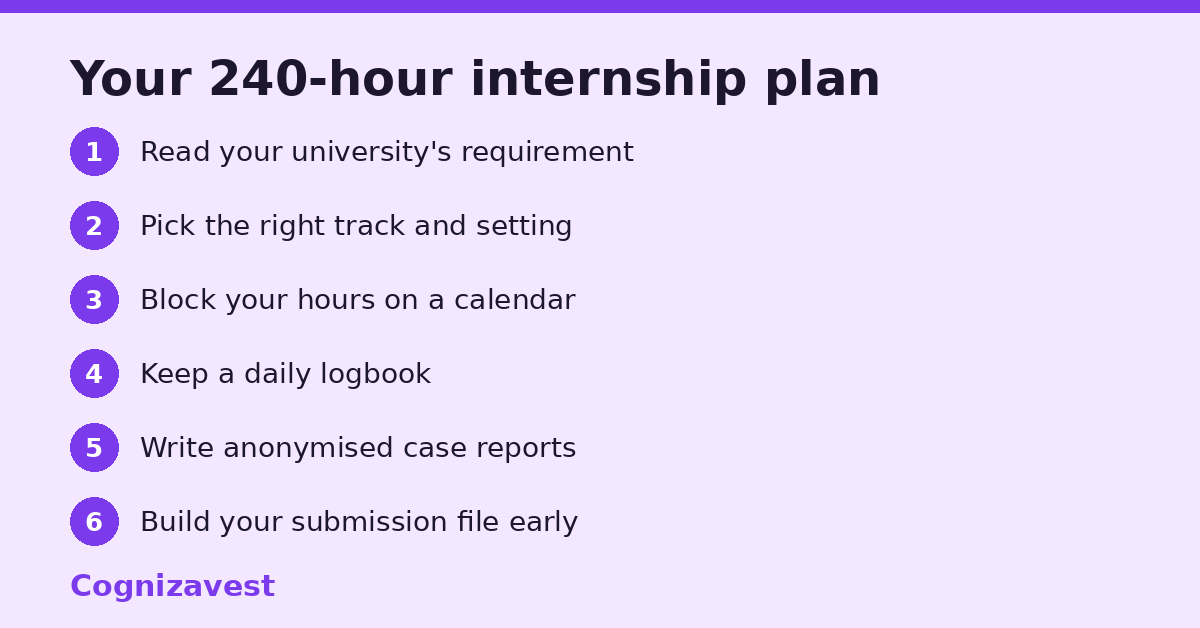
Step 4: Keep a logbook from day one
The logbook is your evidence. Students who rebuild it from memory at the end lose hours, details and credibility. Keep one row per day:
| Date | Activity | Hours | What I learned or practised | Supervisor initials |
|---|---|---|---|---|
| 4 Dec | Live session: taking a case history | 2 | Structured interview, presenting complaints, family history | |
| 5 Dec | Roleplay: first counselling session | 2 | Opening, confidentiality, summarising | |
| 6 Dec | Case Lab and case write-up | 3 | MSE practice on a training vignette |
A few habits make the logbook strong: write it the same day, be specific about skills rather than writing “attended class”, keep a running total, and get it signed weekly if your university needs signatures.
Step 5: Write case reports the professional way
Most psychology internships ask for case reports or case studies. Even when you work on training vignettes, write them as a professional would:
- Identifying information (anonymised), referral and presenting complaints.
- History: personal, family, educational, occupational and medical.
- Mental status examination findings.
- Formulation: what seems to have caused and maintained the difficulty. Our guide to CBT case formulation shows the method step by step.
- Suggested plan and referral, and what you would discuss with a supervisor.
Confidentiality is non-negotiable. Never include names, phone numbers, photographs or details that could identify a real person. Change identifying details and say so in a note.
Step 6: Build your submission file
Two weeks before your deadline, assemble everything in the order your university asks for. A typical file includes:
- Internship certificate with total hours and a verifiable ID.
- Attendance record or logbook with your running total.
- Case reports or case studies.
- Internship report: objectives, activities, learning, reflection and conclusion.
- Letter of recommendation, if your track provides one.
Keep a scanned PDF of the complete file. Universities sometimes ask for resubmission months later.
What should you check before paying for an internship?
- Is the curriculum published? You should be able to see what each set of hours covers.
- Who supervises? Names and qualifications should be available on request.
- Is the work practical? Look for roleplays, case labs and feedback, not only recorded lectures.
- Can the certificate be verified? A unique certificate number that an examiner can check is a strong sign.
- Is the provider honest about limits? No internship certificate is a licence to practise, and no provider can guarantee your university’s decision. Be wary of anyone who promises either.
How Cognizavest’s 240-hour tracks work
Cognizavest runs live online psychology internships in clinical, counselling, child and organisational psychology, with 60, 90, 120 and 240-hour options. The 240-hour tracks run over about two months, include evening live sessions with a weekend Case Lab on the clinical and counselling tracks, and come with a supervisor letter of recommendation. Students who prefer in-person exposure can choose an offline internship at our Pitampura, Delhi centre.
Completion requires attendance and clearing the final case evaluations. Each certificate carries a unique ID that can be verified online. Our hour documentation can support university submissions, but acceptance always depends on your university, so check your requirement first. As with every training certificate, it is not an RCI registration or a licence to practise.
Frequently asked questions
How long does a 240-hour psychology internship take?
Usually six to twelve weeks, depending on how many hours a week you can give. About eight weeks at 30 hours a week is a comfortable pace for most students.
Will my university accept an online internship?
It depends on your university’s rules. Many accept online training hours, some require a field component, and some specify the supervisor’s qualifications. Confirm in writing before you enrol.
Can I split 240 hours across two internships?
Some universities allow it and some don’t. If yours does, keep separate certificates and logbooks for each placement and a combined summary sheet.
What should a psychology internship report include?
An introduction, the organisation and your role, objectives, a week-by-week account of activities, case work (anonymised), skills learned, reflection on challenges, and a conclusion. Follow your university’s template if one is given.
Is a 240-hour internship enough to start practising?
No. An internship builds supervised practical skills. Independent practice requires the qualifications and registration set by the relevant regulator, such as RCI for clinical psychologists.