

















Most CBT students can name the techniques: thought records, behavioural experiments, graded exposure. Fewer can explain why they would pick one technique over another for a particular client. That reasoning comes from the case formulation. This guide walks through CBT case formulation step by step, with a short worked example you can use as a template in your own practice sessions.
If you want to practise formulation with live roleplays and supervisor feedback, see our Cognitive Behavioural Therapy course.
What is a CBT case formulation?
A case formulation is a shared, working explanation of a client’s difficulties. It links what happened in the person’s life, what they believe about themselves, others and the world, and the thoughts, feelings, body sensations and behaviours that keep the problem going today.
A good formulation does three jobs:
- Explains why the problem started and, more importantly, why it continues.
- Guides treatment, so each technique you choose targets a specific link in the cycle.
- Builds collaboration, because the client helps create it and can check it against their own experience.
It is a hypothesis, not a diagnosis. You expect to revise it as you learn more.
What are the main parts of a CBT formulation?
Most CBT formulations, including the widely taught longitudinal model associated with Judith Beck, use the same building blocks:
| Part | What it captures | Question to ask |
|---|---|---|
| Relevant background | Early experiences that shaped the person’s beliefs | “What was it like growing up when things went wrong?” |
| Core beliefs | Deep, global beliefs about self, others, the world | “If that were true, what would it say about you?” |
| Rules and assumptions | “If… then…” rules that protect against the core belief | “What do you tell yourself you must do to be okay?” |
| Triggers | Situations that activate the beliefs now | “When did you last feel this way?” |
| Maintenance cycle | Thoughts, emotions, body, behaviour in the moment | “What went through your mind? What did you do next?” |
| Strengths | Resources, values and supports the client already has | “What has helped, even a little?” |
How do you build a formulation, step by step?
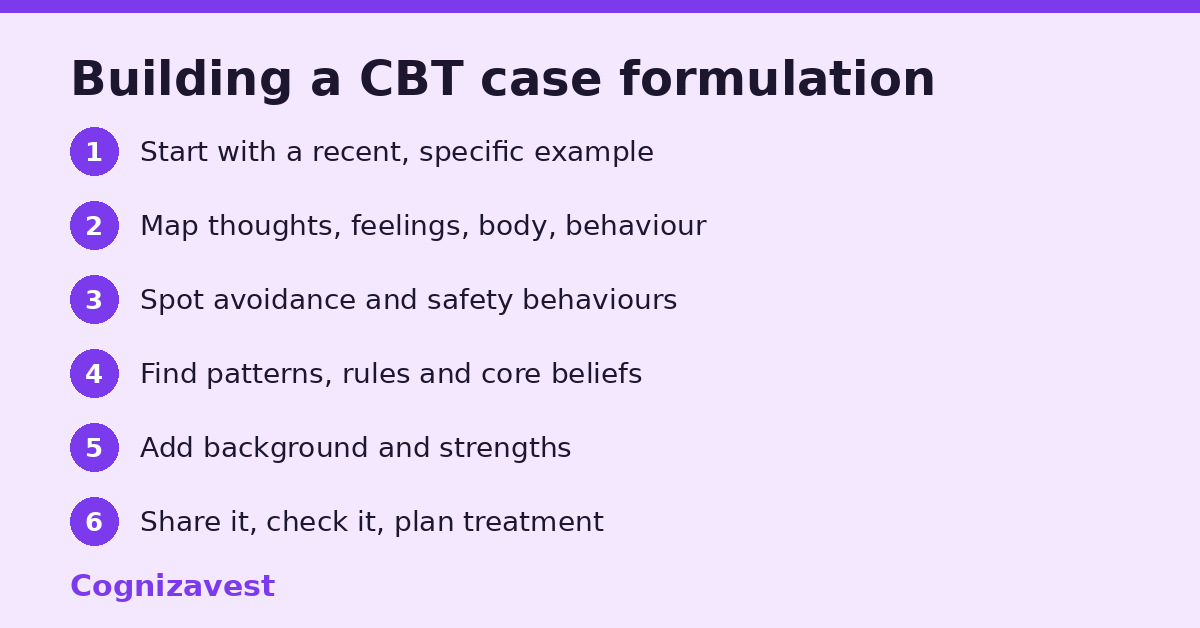
- Start with a recent, specific example. Ask the client to describe one recent moment when the problem showed up. Vague accounts produce vague formulations.
- Map the “hot cross bun” for that moment. Note the situation, the automatic thoughts, the emotions (with intensity out of 100), the body sensations and what the person did.
- Find the maintaining behaviours. Look for avoidance, safety behaviours, reassurance-seeking, checking or withdrawal. Ask what happens to the anxiety or low mood afterwards. Short-term relief usually keeps the problem going.
- Look for patterns across two or three examples. Similar thoughts in different situations point towards rules and assumptions.
- Use the downward arrow to reach core beliefs. Keep asking, “If that thought were true, what would it mean about you?” Go gently; this can bring up strong emotion.
- Add the background. Connect the core belief to experiences that made it understandable. This step is about compassion, not blame.
- Note strengths. A formulation that lists only problems can feel crushing. Strengths also become tools in therapy.
- Share it and check it. Draw it out with the client. Ask, “Does this fit? What would you change?” Revise together.
- Link it to a treatment plan. For each maintaining link, decide which intervention you will try first and how you will measure change.
What does a worked example look like?
This is a fictional training case, written for practice.
Presenting problem: Riya, 24, a postgraduate student, feels intense anxiety before presentations and has started skipping seminars.
Recent example (maintenance cycle):
- Situation: Asked to present a paper in class on Monday.
- Automatic thoughts: “I’ll go blank. Everyone will see I don’t belong here.”
- Emotions: Anxiety 85/100, shame 60/100.
- Body: Racing heart, shaky hands, nausea.
- Behaviour: Over-prepares until 3 am, reads from the script without looking up, then skips the next seminar.
Rules and assumptions: “If I make any mistake, people will think I’m incompetent.” “I must be fully prepared or I shouldn’t speak.”
Core belief: “I’m not good enough.”
Relevant background: High academic expectations at home; mistakes were often pointed out in front of relatives.
Strengths: Hard-working, curious, a supportive friend in her class, has presented successfully in small groups.
How the cycle keeps going: Over-preparing and reading from the script stop Riya from learning that she can cope with small mistakes. Skipping seminars brings relief but strengthens the belief that speaking is dangerous.
Treatment links:
- Thought records to test “Everyone will see I don’t belong” against evidence.
- A behavioural experiment: present one slide with deliberate eye contact and note what actually happens.
- Gradually dropping safety behaviours, such as the full script.
- Later, work on the rule about mistakes and the core belief, using her strengths.
What mistakes do beginners make?
- Jumping to core beliefs too early. Start with the here-and-now cycle. Core beliefs make sense to clients only once they see the pattern.
- Writing it alone. A formulation the client did not help build rarely guides their behaviour.
- Making it a list of problems. Include strengths and values.
- Not linking it to interventions. If a technique does not target a link in the formulation, ask why you are using it.
- Treating it as final. Update it whenever new information changes the picture.
- Working beyond your training. Students should formulate real cases only under qualified supervision, and refer when risk or complexity is high.
How can you practise CBT formulation?
Formulation is a skill you build by doing it many times, ideally with feedback. Practise on written vignettes first, then in roleplays where a peer plays the client. Record your formulation, then compare it with a supervisor’s. Cognizavest’s CBT training includes case work and roleplays with mentor feedback, and our online psychology internship lets you apply these skills to supervised case discussions.
Frequently asked questions
Is a case formulation the same as a diagnosis?
No. A diagnosis names a condition. A formulation explains how this particular person’s difficulties developed and why they continue, and it guides what to do in therapy.
When should a CBT formulation be done?
Usually across the first few sessions, starting with a simple maintenance cycle and adding depth as trust and information grow. It is revisited throughout therapy.
What is the “hot cross bun” model?
A simple CBT diagram linking thoughts, emotions, body sensations and behaviour within a situation. It is a helpful first step before a fuller longitudinal formulation.
Can I use a CBT formulation after a short course?
You can practise it in training and use it under supervision. Independent clinical practice requires the relevant qualifications and registration. A certificate course builds skills; it is not a licence to practise.
Which book should I read on CBT formulation?
Judith Beck’s Cognitive Behavior Therapy: Basics and Beyond and Kuyken, Padesky and Dudley’s Collaborative Case Conceptualization are widely used starting points.