The UGC NET December 2026 exam will be held on 14, 15, 16, 17, 18 and 21 December 2026, as per NTA’s revised schedule. City intimation slips came out on 23 November and admit cards are due on 7 December, so psychology aspirants now have under three weeks left. This guide covers what is confirmed so far, how the paper is structured, what the Psychology (code 04) syllabus expects, and a realistic last-month plan you can start today.
If you are still deciding where psychology can take you after your master’s, our short-term psychology courses and Foundation Course in Psychology are good places to strengthen concepts alongside your NET preparation.
What are the key dates for UGC NET December 2026?
The National Testing Agency (NTA) conducts UGC NET twice a year. For the December 2026 cycle, the dates reported so far are:
| Event | Date |
|---|---|
| Notification and registration opened | October 2026 |
| Last date to apply (with late fee) | 31 October 2026 |
| Application correction window | 2 to 4 November 2026 |
| Revised schedule (corrigendum) | 16 October 2026 |
| Exam city intimation slip | 23 November 2026 (released) |
| Admit card | 7 December 2026 |
| Exam dates | 14, 15, 16, 17, 18 and 21 December 2026 |
The city slip only tells you your exam city; it is not an admit card. Always confirm dates on the official websites, ugcnet.nta.ac.in and nta.ac.in. Your exact date, shift and centre will appear only on your admit card.
What is the UGC NET exam pattern for Psychology?
UGC NET is a computer-based test with two papers taken in one sitting of three hours:
- Paper 1 (General Paper on Teaching and Research Aptitude): 50 questions, 100 marks. Common to all subjects.
- Paper 2 (Psychology, subject code 04): 100 questions, 200 marks.
- Total: 150 objective questions, 300 marks, 2 marks per correct answer.
- No negative marking, so attempt every question.
Because both papers share one three-hour window, time management matters as much as content. Many candidates finish Paper 1 in about 50 minutes and give the remaining time to Psychology.
Which Psychology units should you prioritise?
The Psychology syllabus has ten units. All of them carry weight, but in the last month it helps to sort them by how quickly you can revise them.
| Unit | Focus in the last month |
|---|---|
| 1. Emergence of Psychology | Schools, key thinkers, Indian psychology concepts: quick factual revision |
| 2. Research Methodology and Statistics | Designs, sampling, parametric vs non-parametric tests: high scoring if practised |
| 3. Psychological Testing | Reliability, validity, norms, major tests: memorise with tables |
| 4. Biological Basis of Behaviour | Nervous system, neurotransmitters, methods: revise with diagrams |
| 5. Attention, Perception, Learning, Memory, Forgetting | Classic experiments and theorists |
| 6. Thinking, Intelligence and Creativity | Theories and their proponents |
| 7. Personality, Motivation, Emotion, Stress and Coping | Compare theories in one-page charts |
| 8. Social Psychology | Attitudes, attribution, group processes |
| 9. Human Development and Interventions | Developmental theories, counselling and therapy approaches |
| 10. Emerging Areas | Positive, health, environmental and cross-cultural psychology |
Units 2, 3 and 9 tend to reward students who have hands-on exposure to assessment and therapy. If those feel abstract, practical training such as our Psychological Assessment course or the live CBT certificate course can make the concepts stick, and they stay useful long after the exam.
What does a realistic final-weeks plan look like?
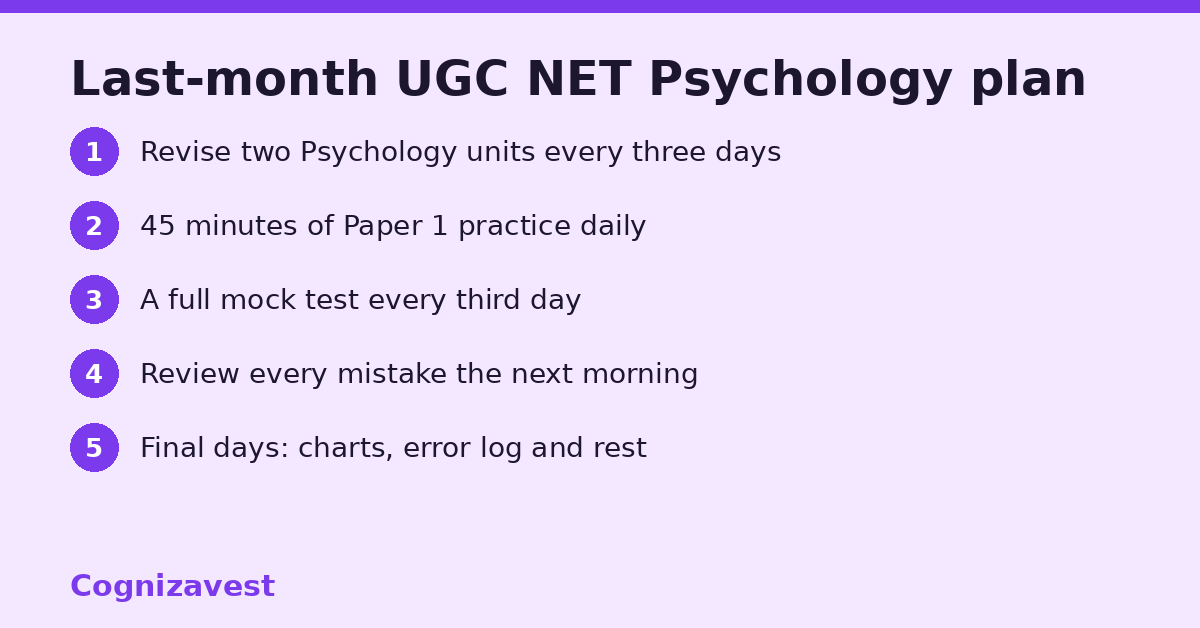
With about 18 days left before the first exam day, aim for steady revision rather than starting new books. Here is a plan many working students can follow:
- Days 1 to 7 (until about 3 December): Revise your weakest Psychology units first, one unit a day, ending with 30 previous-year questions from that unit.
- Every day: 45 minutes of Paper 1, rotating teaching aptitude, research aptitude, reasoning, data interpretation and ICT.
- Days 8 to 14: One full mock test every second day under exam conditions. Spend the next morning analysing every mistake.
- 7 December: Download your admit card and note your date, shift, reporting time and centre address. Plan your route.
- Last 3 days: Revise only your one-page charts and error log. No new topics. Sleep well.
Planning your career beyond the exam? Talk to a Cognizavest counsellor about building practical skills alongside NET preparation, or explore our short-term psychology courses. Chat with us on WhatsApp.
How should you use previous-year papers?
Previous-year questions show you how NTA frames concepts. Use them in three passes:
- Pass 1: Solve unit-wise and mark every question you guessed.
- Pass 2: For each guessed or wrong answer, write the underlying concept in your error log.
- Pass 3: In the final week, re-attempt only the questions from your error log.
Pay special attention to statement-based, assertion-reason and matching questions, which are common in Psychology and reward precise understanding over memorised definitions.
What are common mistakes to avoid in the final weeks?
- Starting a new reference book in the last month.
- Skipping Paper 1 because it feels easy. It carries a third of the total marks.
- Taking mock tests without reviewing them.
- Ignoring statistics and research methods because they feel technical.
- Not checking the exam city slip and admit card as soon as NTA releases them.
How should you manage time on exam day?
A simple time plan prevents panic in the hall:
- First 50 minutes: Paper 1. Answer what you know, mark doubtful questions for review and move on.
- Next 100 minutes: Psychology. Start with the units you revised most recently to build momentum.
- Last 30 minutes: Return to marked questions. With no negative marking, make sure nothing is left blank.
Reach the centre early, carry your admit card and a valid photo ID, and read the instructions on the admit card carefully, as NTA updates them for each cycle.
What comes after UGC NET for psychology graduates?
Qualifying NET makes you eligible for Assistant Professor posts, and JRF qualifiers can pursue funded research. Many psychology graduates also build practice-oriented skills in counselling, assessment or specialised therapies. Remember that NET is an academic eligibility test: practising as a clinical psychologist in India requires RCI-recognised professional training, which is a separate pathway. Our guide on how to become a clinical psychologist in India explains the options.
If you want to strengthen your foundations while you prepare, explore Cognizavest’s live short-term psychology courses, taught by qualified psychologists with roleplays and case work.
Frequently asked questions
When is the UGC NET December 2026 exam?
It will be held on 14, 15, 16, 17, 18 and 21 December 2026. Admit cards are due on 7 December, and your exact date, shift and centre will be on your admit card.
Is there negative marking in UGC NET?
No. There is no negative marking, so you should attempt all 150 questions. Under the revised December 2026 bulletin, answered questions marked for review are also reported to be evaluated, but check the official bulletin and never leave a question unanswered.
How many questions are in the Psychology paper?
Paper 2 (Psychology, code 04) has 100 questions worth 200 marks. Paper 1 has 50 questions worth 100 marks.
Can I still apply for UGC NET December 2026?
The application window, including the late-fee period, closed on 31 October 2026. Watch the NTA website for the June 2027 cycle.
Does qualifying UGC NET allow me to practise as a psychologist?
No. UGC NET is an eligibility test for teaching and research. Clinical practice in India requires RCI-recognised professional qualifications.
How many hours should I study in the last month?
Consistency matters more than long hours. Three to four focused hours a day, with regular mock tests and error review, works for most students.
Sources: dates as reported by Careers360 and CareerPower; always confirm on ugcnet.nta.ac.in.