



















Don’t just learn therapy names. Start thinking therapeutically.
A live online training-based internship in psychotherapies that helps learners understand DBT, REBT, ACT, CBT, Solution Focused Therapy, counselling skills, ethics, case supervision, and therapy selection in a structured practical format.
Therapy Selection
Learn how therapist goals, client needs and case presentation guide the choice of psychotherapy approach.
Psychotherapy training should not feel like a list of therapy names.
Learners often know CBT, DBT, ACT or REBT as definitions, but they still struggle with when to use which approach, how to structure a session, and how to think through a client presentation.
Generic Therapy Training
The passive learning trapTherapy names without application
Students learn definitions but remain unsure how to connect techniques with client needs.
No session-level structure
Concepts remain disconnected from actual therapist communication and session flow.
Limited case thinking
There is little clarity on therapy selection, case formulation, and practical decision-making.
Weak skill confidence
Learners finish with notes, but not enough confidence to explain or demonstrate therapeutic work.
Cognizavest Psychotherapy Internship
The therapy-thinking pathwayApproach first, technique second
Understand the logic behind each therapy before moving into tools and skills.
Case-based therapy mapping
Learn how client presentation guides DBT, REBT, ACT, CBT, SFT or referral decisions.
Live discussion and roleplay lens
Sessions focus on real-time examples, practical explanations and supervised case thinking.
Clear 60, 90 and 120-hour paths
Students can choose a depth level while keeping the learning structured and progressive.
Designed for practice, not just theory.
A practical bridge between therapy concepts and therapist identity, helping learners organize interventions, session choices, and ethical decisions with clarity.
Therapy Selection
Learn how to decide which therapy approach fits a specific client need and presentation.
Session Structure
Understand the therapist’s role, session flow, skill use and intervention sequence.
Case Supervision
Use case discussions to connect theory with realistic client work and therapist responses.
Ethical Practice
Build awareness of boundaries, competence, documentation, and appropriate referrals.
Your psychotherapy learning folder.
By the end of the internship, students build structured therapy notes, model-wise understanding, case thinking records and practical reflection points.
Model Comparison Sheets
Clear notes comparing DBT, REBT, ACT, CBT and SFT in purpose, therapist role and technique use.
Therapy Selection Notes
Practice linking case needs with the most suitable therapeutic direction and intervention plan.
Session Communication Tools
Understand how therapist language, questioning, validation and restructuring appear in session.
Professional Practice Lens
Reflect on boundaries, scope, referrals, supervision needs and responsible application.
Who should join this internship?
This internship is best for learners who want a therapy-focused learning experience with practical direction, not just academic definitions.
Psychology Students
UG/PG learners who want stronger therapy clarity and practical exposure.
Counselling Learners
Learners who understand counselling basics and want to move toward therapy models.
Helping Professionals
Professionals who want mental-health intervention literacy and ethical awareness.
Career-Oriented Learners
Students preparing portfolios, internships, supervised work and future therapy training.
Foundations + DBT
Understand counselling versus psychotherapy, schools of psychotherapy, DBT philosophy and DBT skills.
REBT Application
Study REBT philosophy, ABC model, therapist role and emotional outcomes in practice.
ACT + CBT
Explore ACT philosophy, core processes, CBT structure, therapist role and skill exposure.
SFT + Ethics + Case Supervision
Integrate Solution Focused Therapy, counselling skills, ethics and therapy-selection decisions.
Choose your internship track.
Select a track to see how the syllabus progresses from foundations to therapy application, supervision and ethical decision-making.
Counselling & Psychotherapy
- What is the difference between counselling and psychotherapy
- Schools of psychotherapies
- Therapy orientation and clinical direction
Dialectical Behaviour Therapy
- DBT
- Core philosophy of DBT
- DBT skills
- Skill-based therapeutic application
All 60-Hour Topics
- Counselling versus psychotherapy
- Schools of psychotherapies
- DBT philosophy and skills
Rational Emotive Behaviour Therapy
- REBT
- Core philosophy of REBT
- ABC model
- Role of therapist
- Emotional outcome in REBT
All 90-Hour Topics
- Foundations
- DBT
- REBT
- ABC model and therapist role
Acceptance & Commitment Therapy
- 1 case supervision
- ACT
- Core philosophy
- Role of therapies
- ACT processes
Cognitive Behavioural Therapy
- Cognitive behavioural therapy
- Core philosophy
- Therapist role in CBT
- CBT structure session
- CBT skill exposure
Solution Focused Therapy
- Solution focused therapy
- Core principle
- Techniques in SFT
- Brief therapy application
Professional Integration
- Ethics in psychotherapies
- 2 case supervision
- Basics of counselling skills
- How to select which therapy to use with which case
A globally recognized credential.
Your digital certificate is designed as verifiable proof of internship completion. It supports student profiles, resumes, LinkedIn sharing, and academic documentation needs.
Instant Verification
Certificate verification support through unique credential details.
Professional Credibility
Useful for LinkedIn, resume building, and academic portfolio display.
Documentation Support
Internship completion proof with structured program details.
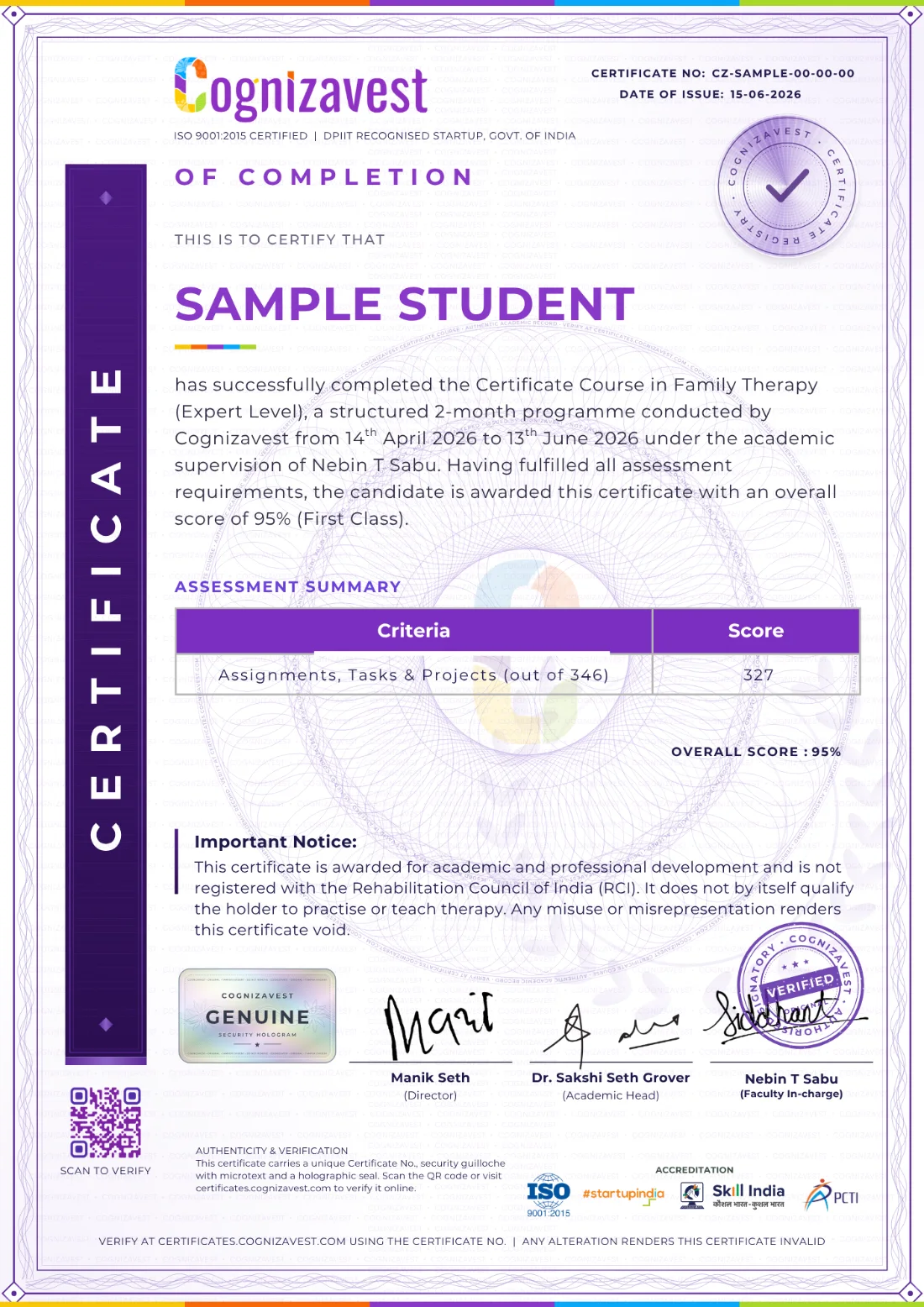
QR Verification
Scan to verify certificate authenticity and completion status.
Unique Credential ID
Each certificate carries a unique ID for documentation and profile validation.
Learning Proof
Shows successful completion of the structured psychotherapies internship.
Meet your Trainers.
Learn directly from practicing psychology trainers who bring therapy-focused teaching, case discussion, and applied learning into the virtual classroom.

Ayesha Narmawala
PGDRP (RCI CRR- A85502), M.A. Clinical Psychology, B.A. Psychology. Experienced in rehabilitation, diagnostics, counselling and clinical intervention training.

Gunja Bhatt
Ph.D. Scholar, M.A. Clinical Psychology, B.A. Psychology, SET Qualified; with teaching, clinical psychology, counselling and psychotherapy-focused experience.
Pick your goal. We’ll suggest the track.
Tap one option and see the recommended internship track for your current learning stage.
What sounds most like you?
Choose the option closest to your current need.
Start with 60 Hours Track
Best if you want psychotherapy to feel less intimidating and more structured. You will build foundations first, then understand DBT philosophy and skills.
Ready to begin your psychotherapy internship?
Choose your batch date and internship hours. Your seat will be reserved through secure checkout.
Live online Internship in Psychotherapies with structured therapy model learning, recordings and digital certificate.
Select batch & hours
Choose your preferred upcoming batch date.
Don't just take our word for it.
Hear directly from students who experienced the Cognizavest interactive learning ecosystem and structured, practical training.
“The sessions were thoughtfully structured, and your facilitation style created a safe, encouraging, and non-judgmental space for everyone to participate.”
Sridhar Chadalawada
Cognizavest Learner“She is the best psychology teacher I've had till date. She was very insightful and she made the sessions very interactive and helpful.”
Khushi
Cognizavest Learner“Very interactive, explained everything very well. I was looking for a practical oriented course rather than just learning theories and this is it.”
Samantha
Cognizavest Learner“I am really grateful for the way you taught in class and the cases we discussed. It helped a lot, especially the role plays.”
Prerna
Cognizavest Learner“The concepts were explained in a way that made learning easier. It felt practical, supportive, and engaging throughout.”
Arnav Dev Singh
Cognizavest Learner“I particularly appreciate the use of real-life cases, as it makes the learning more practical and relatable.”
Saakshi V
Cognizavest LearnerGot questions? We've got answers.
Select a category below to find everything you need to know about the internship format, payments, certificates, and enrollment.
Still need help?
Our academic counselors are available on WhatsApp to help you choose the right track.
Message SupportYes. Classes are conducted live online through Google Meet from 8 PM to 9 PM. Recording access is included for revision and catch-up.
The internship is suitable for psychology students, counselling learners, helping professionals and learners who want structured psychotherapy exposure.
It means the learning is structured around models, skills, case discussion, therapy selection and application rather than passive theory only.
The registration section calculates the total based on your selected 60, 90 or 120-hour track before checkout.
The secure checkout can accept supported payment methods available through the website payment gateway, such as UPI, cards, net banking, and wallets, depending on gateway availability.
Cognizavest follows a strict no-refund policy. Batch shifting may be considered only as per the applicable policy conditions.
After successful checkout, you should receive confirmation. The onboarding team will then share batch access and class details through the usual communication channel.
Yes. Recording access is included so students can revise or catch up if they miss a live session.
The digital certificate is provided after successful completion of the internship requirements as per Cognizavest’s certificate processing timeline.
