



















Counseling & Psychotherapy Course · Advanced CertificateLearn to listen like a therapist.
A live, online Certificate Course in Counseling & Psychotherapy. In 3 months and 60 hours, learn to open a first session, take a case history and MSE, notice risk, formulate the case and choose between CBT, REBT, behaviour therapy, ACT, MET, family and group work, with 12+ hours of supervision exposure.
Hear what’s beneath the words.
One client statement holds five kinds of information. Scroll, and watch a trained counsellor’s attention move through it.
“I haven’t slept properly in weeks and I can’t focus at work. I always mess everything up. My partner says I’ve changed. Honestly, some nights I think everyone would be better off without me. But I still go for my morning walk, and I want to feel like myself again.”
Listen for symptoms
Poor sleep for weeks and reduced concentration: note onset, duration and impact on functioning. This is where case history, interview and MSE begin.
Notice the thinking pattern
“Always” and “everything” signal overgeneralisation and a harsh core belief: a natural target for CBT, cognitive restructuring and REBT.
See the system
A partner noticing change puts the concern inside a relationship. Family and systemic thinking widen the picture beyond one person.
Hear the risk, every time
Passive thoughts of being a burden must never be skipped. Ask directly and calmly, assess safety, and refer when needed.
Find strengths and motivation
The morning walk is a protective routine; “I want to feel like myself again” is change talk. MET and ACT build on exactly these.
That is clinical listening.
Five layers in one paragraph. The course trains you to hear all of them, then respond in the right order: safety first, then formulation, then intervention.
Learn to listen like thisThe sequence behind responsible counselling.
Five stages every learner practises. Tap a stage, or watch the session unfold.
Observe like a clinician: the Mental Status Examination.
Tap each MSE domain to write the note for a sample client. Module 1 covers case history, interview, observation, MSE and basic screening tools such as BAI, BDI and AUDIT.
0 of 9 domains noted
- Tap a domain to begin your note…
Illustrative example for learning. Not a real client.
One client. Five therapy lenses.
The same concern looks different through each approach the course teaches. Switch the lens to see how the work changes.
“I lost my job three months ago. I’m a failure. There’s no point applying again, so I just stay in bed scrolling.”
Sixteen tools. Pack your kit.
Every tool below is taught in this course. Tap to add it to your kit and see what it’s for.
Each tool shows what it is used for in real counselling work.
For psychology learners ready to become more applied.
Who joins
- Bachelor’s students pursuing or completing psychology
- Master’s students pursuing or completing psychology
- Counsellors, psychologists and helping professionals
- Professional use stays within your existing qualifications and scope
Three modules. One connected pathway.
From counselling theory and assessment, to therapy in non-clinical settings, to therapy in clinical settings.
The program strengthens counselling and psychotherapy knowledge. It does not independently grant a licence for clinical practice, diagnosis or psychotherapy outside your existing qualifications and supervision.
01Module 1: Counseling Theory3 units · Introduction to Psychotherapy and Counseling, Method of Eliciting Information, Abnormal Psychology
- Introduction to Psychotherapy and Counseling
- Definitions and objectives
- Models of counseling and schools of psychotherapy
- Ethics of counseling and therapy sessions
- Difference between counseling and psychotherapy
- Method of Eliciting Information
- Case history and Mental Status Examination (MSE)
- Interview and observation
- Basic screening tools: BAI, BDI and AUDIT
- Psychoeducation
- Abnormal Psychology
- Depression, anxiety and OCD
- Neurodevelopmental disorders, schizophrenia and bipolar disorders
- Trauma- and stress-related and dissociative disorders
- Somatic symptoms, eating disorders, sexual dysfunction and gender dysphoria
- Disruptive and conduct, substance-related and personality disorders
02Module 2: Therapy in Non-Clinical Setup5 units · Crisis Intervention, Group Therapy, Family Counseling / Therapy…
- Crisis Intervention
- Definition and phases of crisis
- Techniques and stages of crisis work
- Applications
- Group Therapy
- Theoretical models and types of groups
- Stages and process issues
- Therapist role, techniques and applications
- Family Counseling / Therapy
- Family assessment models
- Common problems and intervention goals
- Methods and ethical issues
- Solution-Focused and Narrative Therapy
- Meaning and principles
- Techniques and applications
- Children and Special Conditions
- School counseling
- Parent and family counseling
- Play therapy
03Module 3: Therapy in Clinical Setup4 units · Behavior Modification and Therapy, Cognitive Therapies, Motivational Enhancement Therapy…
- Behavior Modification and Therapy
- Behavioral assessment, analysis and formulation
- Relaxation and social skills training
- Operant procedures and systematic desensitization
- Cognitive Therapies
- Cognitive model and core assumptions
- Cognitive restructuring
- Rational Emotive Behavior Therapy (REBT)
- Motivational Enhancement Therapy
- Motivational interviewing
- MET principles and phases
- Session planning
- Acceptance and Commitment Therapy
- Meaning and principles
- Core techniques
Not just therapy names. Therapist decision-making.
Learn why an intervention fits, not only how it is performed.
Three professional lenses, one applied room.
Counselling and family systems, rehabilitation and clinical psychology, and research-grounded teaching. Tap a card to meet each trainer.
Remembered for clarity, practice and connection.
Reflections from earlier Cognizavest counselling and psychology learners. Tap any review to read it in focus.
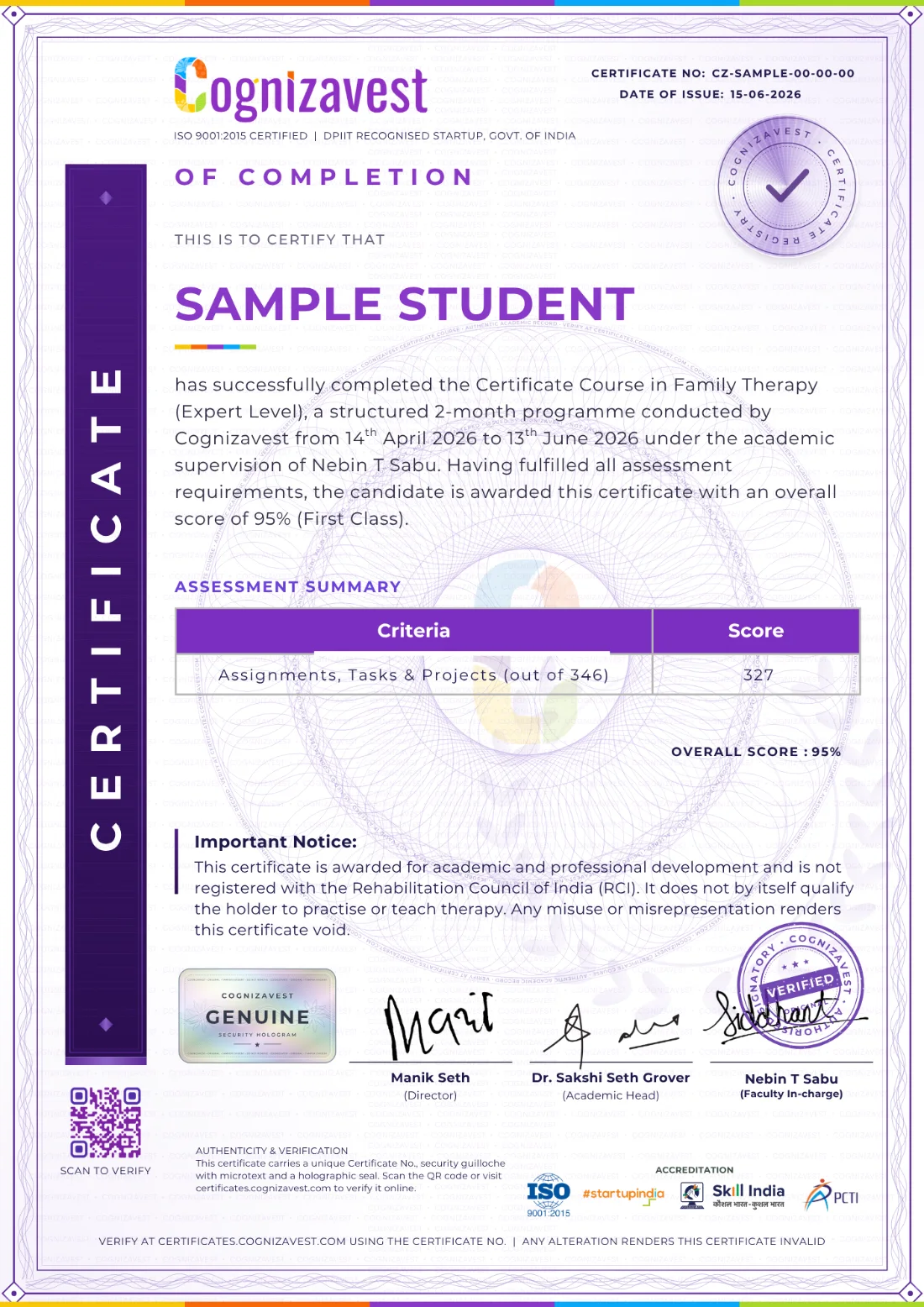
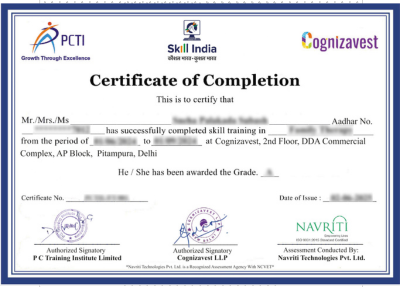
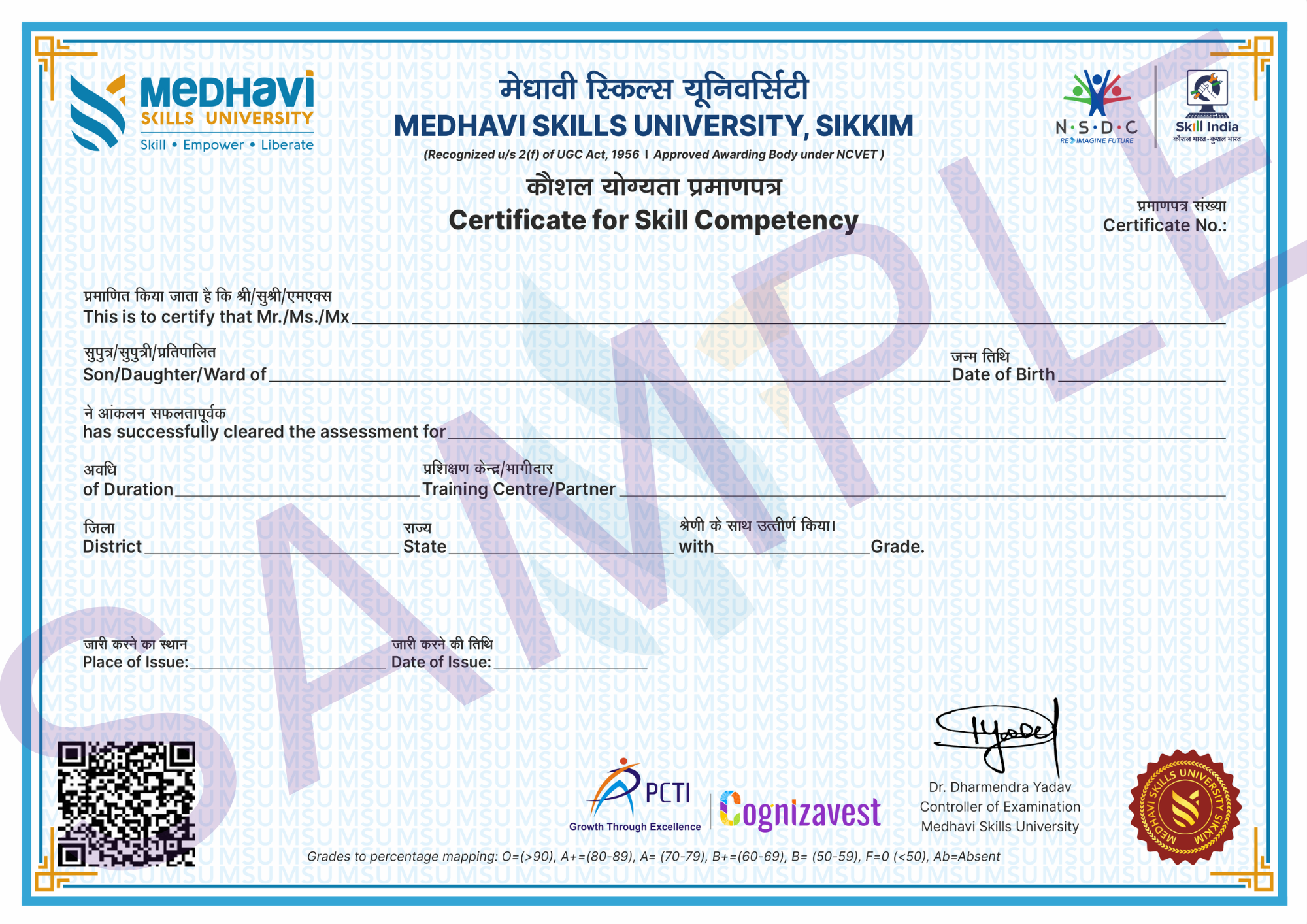
Make your learning visible.
The Cognizavest Advanced Certificate is included. You can add the NCVET Skill India certificate, and can also opt for a university certificate.
- 01Cognizavest Advanced Certificate Included
Issued after completion of course requirements. Supports your CV, LinkedIn and learning portfolio.
- 02NCVET Skill India certificate + ₹1,500
Optional add-on, opted for separately through enrollment support.
- 03University certificate + ₹2,500
Optional Certificate for Skill Competency issued by Medhavi Skills University after assessment. Can be combined with NCVET.
Note: add-on certificate fees (NCVET ₹1,500, university ₹2,500) are optional, not part of online checkout, and are collected separately by our team after you enroll. Certificates document training; they do not independently license practice.
Choose how you want to secure your seat.
Pay the complete fee, or start the monthly plan with ₹3,000 today. Add resources if you want them, and check out.
Advanced Level · 3 Months
Secure SSL checkout
Questions before you pay? Chat with us on WhatsApp
Everything to know before you join.
Tell us your background and we will help you decide if this course fits.
Ask on WhatsAppWhat is the difference between counseling and psychotherapy?
Counseling usually focuses on specific current concerns, adjustment and coping over a shorter period, while psychotherapy tends to work more deeply with longer-standing patterns, emotions and behaviour. The course covers both, starting with their definitions, models, ethics and differences in Module 1.
When does the new batch begin?
The new batch starts on Friday, 8 January 2027. Live online classes are held every Friday and Saturday from 5 PM to 6 PM IST, over 3 months.
Who can join the course?
Bachelor’s and Master’s psychology students, psychology graduates, counsellors, psychologists and allied helping professionals with a relevant academic or professional background.
What is the course fee? Is there a monthly plan?
The complete 3-month Advanced Level fee is ₹8,999. You can also choose the monthly plan: ₹3,000 at registration, ₹3,000 after the first month and ₹3,000 after the second month.
What does the course cover?
Counseling theory and ethics; case history, MSE, interview, observation and screening tools (BAI, BDI, AUDIT); abnormal psychology; crisis intervention; group, family, school and parent counseling; solution-focused and narrative therapy; play therapy; behaviour therapy; cognitive therapies and REBT; motivational enhancement therapy; and acceptance and commitment therapy.
How many hours of training and supervision are included?
The course includes 60 hours of structured learning, 12+ hours of supervision exposure and carries 2 credits.
Which certificates are available?
The Cognizavest Advanced Certificate is included after completion requirements are met. You can add the NCVET Skill India certificate (₹1,500) and, as a third optional choice, a university Certificate for Skill Competency from Medhavi Skills University (₹2,500). Add-on fees are collected separately by our team after enrollment.
Who are the trainers?
The trainers are Dr. Sakshi Seth Grover, Ayesha Narmawala and Wasuddha Tikmani. Trainer allocation and session distribution may vary while the stated learning outcomes remain consistent.
Are classes live and interactive?
Yes. Classes are live online with discussion, examples, case-based understanding and application-focused learning. Recording support may be provided according to the program process.
Are hardcopy notes available?
Yes. Hardcopy course notes are an optional ₹499 add-on. A Diary (Premium Matte Notebook) can also be added for ₹199, or ₹99 with hardcopy notes.
Does the certificate allow independent psychotherapy practice?
No. The certificate documents professional learning. Counselling, diagnosis or psychotherapy must remain within your existing qualifications, competence, legal scope and supervision requirements.
What is the refund policy?
Cognizavest follows a strict no-refund policy for programs. Batch shifting may be considered only as per policy timeline and conditions.
Your first session starts long before the client arrives.
Live classes every Friday and Saturday, 5–6 PM IST. 3 months, 60 hours, 12+ hours of supervision exposure.
